by Dr. Reema Sethi | Nov 13, 2025 | Skincare
Why Hair Restoration Matters for Your Well-Being
Hair restoration refers to surgical and non-surgical treatments that combat hair loss and restore a fuller head of hair. Whether you have a receding hairline or thinning at the crown, there are effective options available.
Quick Overview of Hair Restoration Options:
- Surgical: Hair transplant surgery (FUT or FUE) permanently relocates hair follicles to thinning or bald spots.
- Medications: Minoxidil (topical) and Finasteride (oral) slow hair loss and can encourage regrowth.
- Advanced Therapies: PRP injections, laser therapy, ultrasound, and exosomes all stimulate follicles.
- Expected Results: Surgical results appear in 6-12 months; non-surgical options require ongoing use for maintenance.
- Cost Range: $4,000-$15,000 for surgery; non-surgical options vary by treatment.
Hair loss affects more than just your appearance. As patient Oscar C. shared, “Getting my hair back was priceless… the beginning of getting back my confidence and life.” Studies show that 95% of first-time hair restoration surgery patients in 2024 were between ages 20-35, highlighting how deeply hair loss can impact self-esteem during socially active years.
The good news is that modern hair restoration has evolved far beyond the “hair plugs” of the past. Today’s techniques create natural-looking results that blend seamlessly with your existing hair. Whether you choose a permanent surgical solution or prefer non-surgical approaches, the path to regaining your confidence is clearer than ever.
Understanding your options is the first step. Some people achieve their desired results with a single surgical procedure—in fact, 68% of surgeons surveyed typically require only one procedure for success. Others find that combining treatments, like a transplant with ongoing medication, provides the best long-term outcome.
Your journey to restored hair doesn’t have to be overwhelming. As Dr. Reema Sethi, a board-certified physician with over 15 years of clinical experience in medical aesthetics, I develop individualized hair restoration treatment plans at Aura Health and Spa. My approach combines evidence-based medicine with a deep understanding of how hair loss affects your well-being, ensuring you receive safe, effective, and compassionate care.
Understanding Hair Loss: The First Step to Restoration
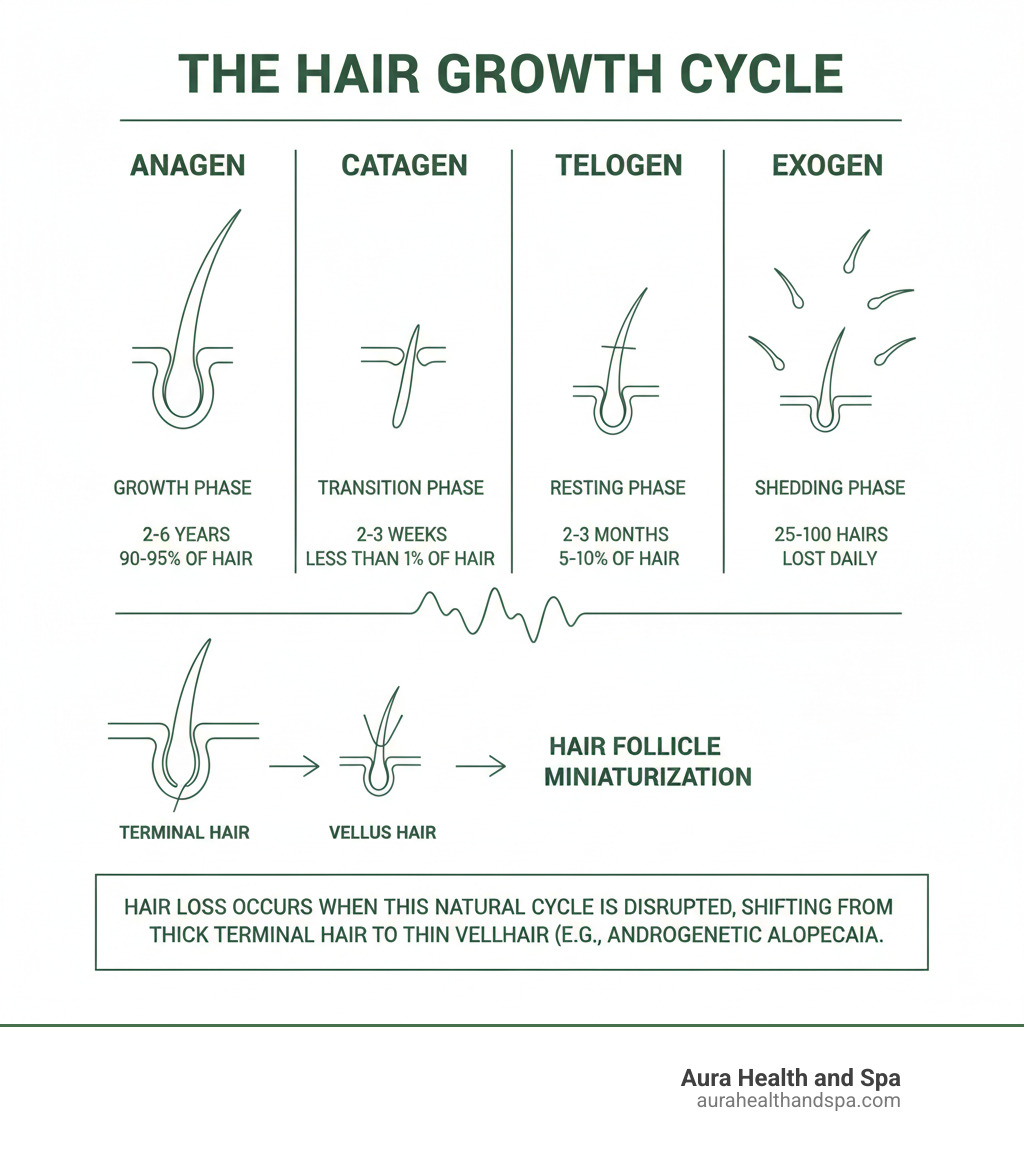
Before exploring treatments, it’s helpful to understand what causes hair loss. It isn’t just a cosmetic issue—it carries an emotional weight that can affect your confidence and how you steer the world.
Noticing a receding hairline or more hair on your pillow can be unsettling. Many of my patients feel self-conscious, avoid photos, or withdraw from activities they once enjoyed. As our patient Erick S. shared, hair restoration helped him regain confidence and feel proud of his hair again. This emotional dimension is why understanding the root cause is the foundation for choosing the right path forward.
The most common reason for hair loss is androgenetic alopecia, or pattern baldness. This hereditary condition is driven by genetics and hormones, affecting men and women differently.
Male pattern baldness often begins with a receding hairline and thinning at the crown, which can expand until only a horseshoe pattern of hair remains. Female pattern baldness typically involves overall thinning across the top of the scalp rather than a receding hairline. While complete baldness is rare in women, the thinning can be significant. The number of women seeking surgical hair restoration grew by 16.5% between 2021 and 2024, showing how many are actively addressing this concern.
Beyond pattern baldness, other factors can trigger hair loss. Hormonal changes from pregnancy, menopause, or thyroid conditions can cause thinning. Aging naturally slows hair growth, and genetics plays a powerful role—if your parents experienced hair loss, your chances increase. We explore the causes of male hair loss in our article, Top Causes of Hair Loss in Men: Understand the Facts.
Let’s clear up some common myths. Wearing hats, poor scalp circulation, and dandruff do not cause hair loss. While severe vitamin deficiencies can contribute, minor dietary gaps are not a typical cause. And the idea that baldness is inherited only from your mother’s father is false; the genetics are far more complex.
Hair loss is a nuanced medical issue. Some people experience rapid progression, while others notice gradual thinning over decades. A proper medical assessment is required to understand what’s causing your hair loss. Tools like the Norwood scale for men and the Ludwig scale for women help categorize the extent of hair loss so you can make informed decisions about treatment.
Surgical Hair Restoration: A Permanent Solution
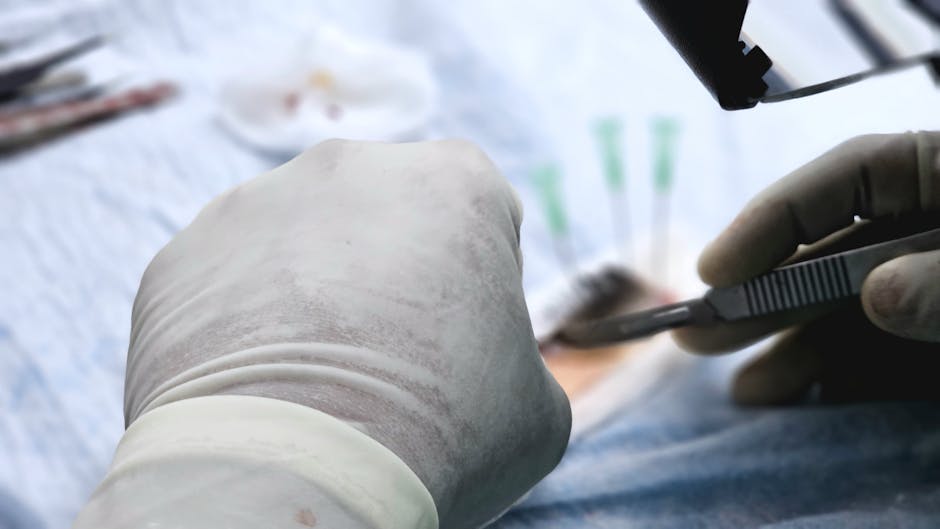
For those seeking a lasting solution, surgical hair restoration is a highly effective and often permanent option. Hair transplant surgery relocates healthy, genetically resistant hair follicles from a “donor area” (typically the back and sides of the head) to thinning or bald areas. These transplanted follicles retain their resistance to balding hormones and will continue to grow hair in their new location.
The benefits extend beyond a fuller head of hair. It’s a proven method for restoring a natural-looking hairline and increasing density, which can significantly boost self-confidence. The International Society of Hair Restoration Surgery (ISHRS) promotes high standards of medical practice and ethics in this field, ensuring patient safety. For a comprehensive overview, you can refer to the Hair Transplantation overview from the National Library of Medicine.
When considering surgical hair restoration, the two main techniques are Follicular Unit Transplant (FUT) and Follicular Unit Extraction (FUE). They differ in how donor hair is harvested.
-
Follicular Unit Transplant (FUT), or the “strip method,” involves removing a strip of hair-bearing skin from the donor area. This strip is dissected into individual follicular units. FUT allows for a large number of grafts in a single session and can have high graft survival rates. Its main drawback is a linear scar at the donor site, which may be visible with very short hair.
-
Follicular Unit Extraction (FUE) involves extracting individual follicular units directly from the donor area with a small punch tool. This leaves tiny, dot-like scars that are less noticeable, making it ideal for those who wear their hair short. FUE is less invasive with a quicker donor area healing time but can be more time-consuming. Robotic-assisted FUE is an advancement that uses technology to aid in precise extraction.
Here’s a comparison of FUT and FUE:
| Feature |
Follicular Unit Transplant (FUT) |
Follicular Unit Extraction (FUE) |
| Scarring |
Linear scar at donor site, potentially noticeable with short hair |
Tiny, circular dot scars, less noticeable, allows for shorter hair |
| Recovery Time |
Longer healing for donor incision (approx. 1 week) |
Quicker healing for donor area (a few days) |
| Procedure Time |
Often shorter for harvesting large number of grafts |
Can be longer due to individual follicle extraction |
| Ideal Candidate |
Patients needing a large number of grafts, okay with linear scar, prefer longer hair |
Patients wanting minimal scarring, prefer shorter hair, or have tighter scalps |
The Hair Transplant Journey: From Consultation to Recovery
Your hair restoration journey begins with a thorough consultation to discuss your concerns and establish realistic expectations. We recommend seeking a board-certified specialist with experience in hair restoration.
During your consultation, be ready to discuss your medical history and hair loss progression. Ask about the surgeon’s experience, the recommended technique, potential outcomes, and costs.
The procedure typically involves these steps:
- Anesthesia: Local anesthesia is used to numb the donor and recipient areas for your comfort.
- Harvesting: Hair follicles are harvested from the donor area using either the FUT or FUE method.
- Implantation: Tiny incisions are made in the recipient areas, and the harvested follicular units are delicately placed to create a natural-looking pattern. The process can take several hours.
The recovery phase is crucial. Your scalp may be tender with some swelling, managed with medication. Transplanted hairs typically shed within 2-3 weeks—this “shock loss” is normal. New hair growth usually appears within 3-4 months, with significant improvement by 6-9 months and final results at 12-18 months. Following post-operative care instructions is essential for success. For detailed guidance, see our article on Key Best Practices for Hair Care Post Restoration Treatment.
Potential Risks and Realistic Expectations for Hair Restoration
While modern hair restoration is generally safe, it’s important to be aware of potential risks and have realistic expectations. Side effects can include temporary swelling, numbness, bleeding, or infection. Scarring is inherent to the procedures, but proper technique minimizes visibility. Folliculitis (inflammation of hair follicles) can also occur. Choosing a qualified, experienced surgeon is paramount to avoid unnatural-looking results.
It’s also crucial to know the signs of a hair transplant gone wrong, such as poor growth after 9-12 months, an unnatural hairline, or highly visible scars. A rare but serious complication is scalp necrosis (death of scalp tissue). Contact your doctor immediately if you experience heavy bleeding, signs of infection (pus, fever), an open wound, dusky skin, or severe facial swelling.
The success rate of hair restoration is high, with 68% of surgeons surveyed typically requiring only one procedure for a successful transplant. However, results vary, and multiple sessions may be needed for desired density. The full, mature results take 12-18 months to develop.
Exploring Non-Surgical Hair Restoration Options
Not everyone is ready for surgery, and non-surgical hair restoration options offer effective alternatives. These less invasive approaches can work well on their own or to improve surgical results. They are especially valuable for early-stage thinning or for those who prefer a gentler path to fuller hair.
Starting with non-surgical treatments allows you to actively address hair loss while exploring your options. At Aura Health and Spa, we offer a comprehensive range of professional solutions to meet you where you are in your journey. You can explore these in our article Discover Professional Hair Restoration Options for Hair Loss.
FDA-Approved Medications
Two FDA-approved medications have helped countless people maintain and regrow hair.
Minoxidil (Rogaine) is an over-the-counter topical treatment (foam, liquid, or shampoo) applied directly to the scalp. It works by increasing blood flow to hair follicles and extending the hair’s growth phase. It is effective for thinning on the crown but requires patience and consistency. Results typically take at least six months to appear, and you must continue using it to maintain the benefits.
Finasteride (Propecia) is a prescription oral medication for men. It works by blocking the enzyme that converts testosterone to DHT, the hormone that shrinks hair follicles in pattern baldness. By reducing DHT levels, finasteride can slow hair loss and encourage new growth. Like minoxidil, it requires ongoing use and a discussion with your healthcare provider to see if it’s right for you.
Advanced Therapies: PRP and Laser Treatments
Cutting-edge therapies are also available for hair restoration, using your body’s healing abilities and technology to stimulate growth.
Platelet-Rich Plasma (PRP) therapy is a promising non-surgical treatment. We draw a small amount of your blood, concentrate the platelets rich in growth factors, and inject this plasma into your scalp. These growth factors can awaken dormant follicles, encourage new growth, and improve hair thickness. PRP works well as a standalone treatment or alongside a hair transplant. Our blog post, Essential PRP Hair Restoration Benefits for Thinning Hair, explores its advantages.
Low-Level Laser Therapy (LLLT) offers another non-invasive path. These FDA-approved devices (combs, helmets, or caps) emit low-power laser light onto the scalp. This energy stimulates cellular activity in hair follicles, encouraging them to enter the growth phase and produce thicker hair. LLLT is approved for hereditary hair loss in both men and women and is convenient for home use.
At Aura Health and Spa, we use advanced Folix Laser Technology. This system delivers improved performance and superior results for clients seeking to revitalize their hair. Learn more in our article, Folix Laser Technology: Enhancing Performance and Results.
Frequently Asked Questions about Hair Restoration
It’s natural to have questions when considering hair restoration. Here are answers to some of the most common concerns we hear from patients.
How much does hair restoration cost?
The cost of hair restoration depends on the treatment type, the extent of your hair loss, and your location. Prices can differ between our clinics in Plymouth, Sterling Heights, and Ann Arbor, Michigan.
Surgical hair transplants generally range from $4,000 to $15,000. The final price depends on the number of grafts needed and the technique used. FUE procedures may have a higher per-graft cost due to the time-intensive nature of individual follicle extraction. Your surgeon’s experience also influences the price.
Non-surgical options have a different pricing structure. Medications like minoxidil and finasteride involve ongoing monthly costs. PRP therapy is typically priced per session, with a series of treatments recommended for best results. Our article on PRP Hair Restoration: Understand the Average Treatment Costs breaks this down. At-home laser therapy devices require a one-time investment.
Most insurance plans do not cover hair restoration as it is considered a cosmetic procedure. We will provide a precise cost estimate during your personalized consultation at Aura Health and Spa.
Are hair transplants permanent?
Yes, the results of a hair transplant are permanent. The transplanted follicles are taken from areas of your head where hair is genetically programmed to resist balding. When moved to a new area, they retain this resistance and will continue to grow hair for life.
However, it’s important to understand that your native (non-transplanted) hair may continue to thin over time. The transplanted hair is protected, but the hair that was already vulnerable remains so.
This is why many patients combine their transplant with non-surgical treatments like minoxidil or finasteride. These medications help protect your existing hair, preventing further loss and preserving your overall density for years to come.
Who is a good candidate for a hair transplant?
Not everyone is an ideal candidate for surgical hair restoration, but other solutions may be right for you.
The best candidates have sufficient healthy donor hair on the back and sides of their head. A relatively stable pattern of hair loss is also preferred. Certain conditions, like active alopecia areata, may not be suitable for transplantation, as the underlying issue could affect the survival of transplanted hair.
Realistic expectations are crucial. Hair restoration can create dramatic improvements, but it works with the donor hair you have. Good overall health is also important for any surgical procedure.
While statistics show that 95% of first-time hair restoration patients in 2024 were between ages 20-35, many surgeons prefer to wait until hair loss patterns stabilize, often after age 25, to ensure better long-term results.
During your consultation at Aura Health and Spa, we will evaluate your hair loss, assess your donor hair, and discuss your goals to determine if you are a good candidate for surgery or if non-surgical options would better serve your needs.
Conclusion: Your Path to Renewed Confidence
Your hair restoration journey is about more than regaining hair—it’s about reclaiming the confidence that hair loss can diminish. We’ve explored the full spectrum of options, from permanent surgical solutions like FUT and FUE to non-surgical approaches like medications, PRP, and laser therapy. The right choice depends on your individual goals, circumstances, and lifestyle.
What matters most is that you don’t have to steer this journey alone. At Aura Health and Spa, we understand that hair restoration is deeply personal. Under the guidance of Dr. Reema Sethi, who brings over 15 years of clinical experience to every consultation, we create treatment plans that honor your whole person.
Our holistic approach means we see the bigger picture. We use advanced medical treatments and technology, but we also recognize that true well-being comes from feeling comfortable in your own skin. Whether you’re just noticing thinning or have been dealing with hair loss for years, we’re here to provide compassionate, evidence-based care.
The most important step is often the first one: reaching out for a conversation. During a professional consultation at any of our locations in Plymouth, Sterling Heights, or Ann Arbor, Michigan, we’ll listen to your concerns and map out a realistic path forward. You’ll leave with clarity about your options and confidence in your next steps.
If you’re curious about how advanced laser technology might fit into your plan, we invite you to learn more about our advanced Folix Laser hair restoration services. This is just one of the many tools we use to help you achieve the natural, lasting results you deserve.
Your hair restoration journey can begin today, leading you back to feeling like yourself again.
by Dr. Reema Sethi | Nov 13, 2025 | Skincare
Why Collagen Induction Therapy Is Changing Skin Care
Collagen induction therapy near me is one of today’s most sought-after skin rejuvenation treatments. Also known as microneedling, this minimally invasive procedure uses fine needles to create controlled micro-injuries, triggering your body’s natural healing process to boost collagen and elastin production.
Quick Answer: Finding Collagen Induction Therapy Near You
- What it is: A minimally invasive treatment using fine needles to stimulate collagen production
- Where to find it: Look for board-certified providers at medical spas and dermatology clinics
- What to expect: 30-90 minute sessions with minimal downtime (1-3 days of redness)
- Results timeline: Immediate glow, with continued improvement over 4-6 weeks
- Typical cost: $250-$800 per session
- Sessions needed: 3-6 treatments spaced 4-6 weeks apart
The treatment’s popularity is soaring, with the global market projected to grow 7.8% annually through 2030. Microneedling works by creating microscopic channels that signal your body to rush collagen-producing cells to the area. The result is smoother texture, reduced scarring, and smaller pores. Unlike aggressive lasers, it’s safe for all skin types and treats everything from acne scars to sun damage with little downtime.
As Dr. Reema Sethi, a board-certified emergency medicine physician with over 15 years of clinical experience, I’ve applied my medical expertise to deliver safe, science-backed collagen induction therapy near me at Aura Health & Spa in Plymouth, Michigan. I believe in subtle, natural-looking results that help you feel like the best version of yourself.
This guide will walk you through everything you need to know about collagen induction therapy: how it works, what to expect, and if it’s right for your skin goals.
What is Collagen Induction Therapy and How Does It Work?
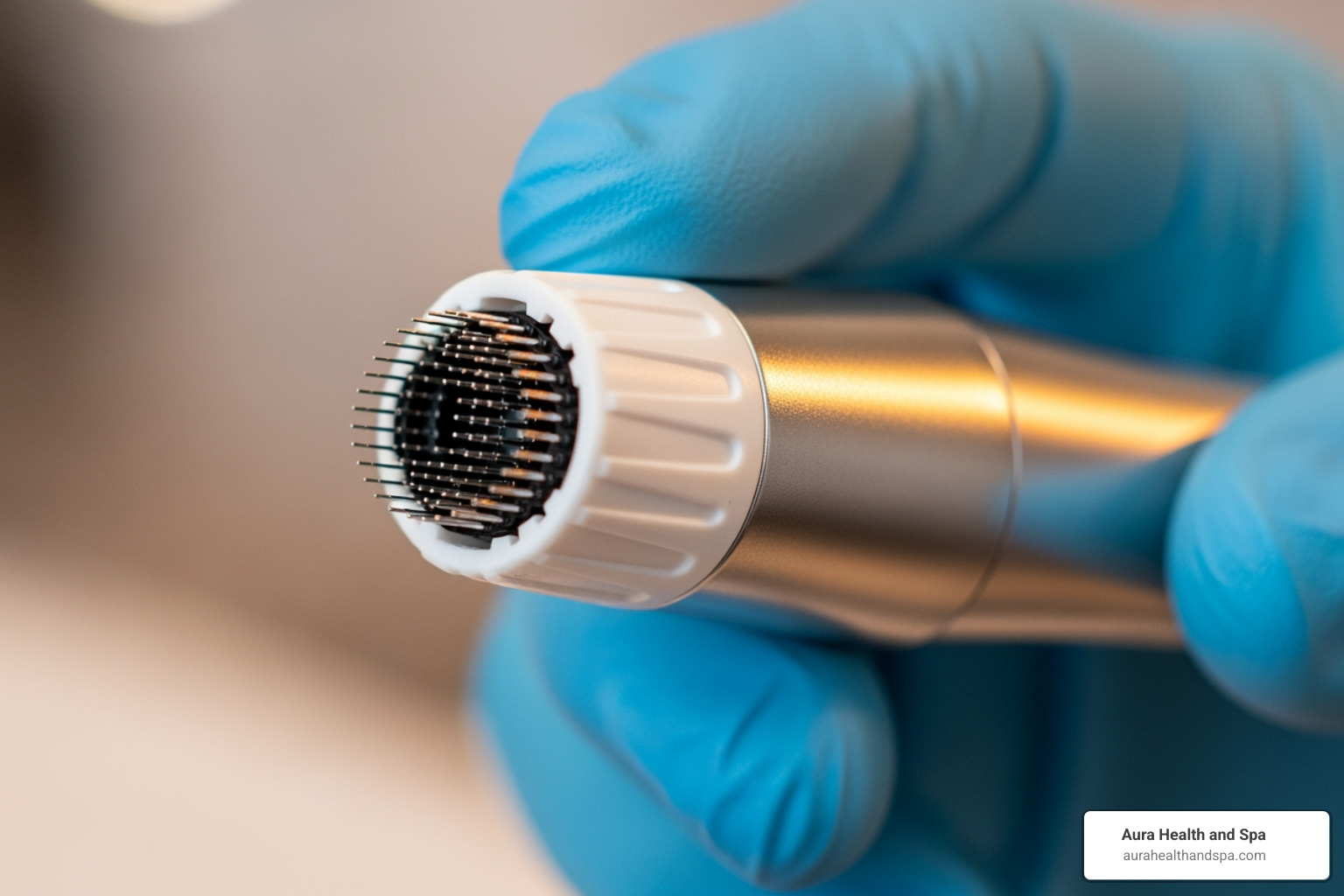
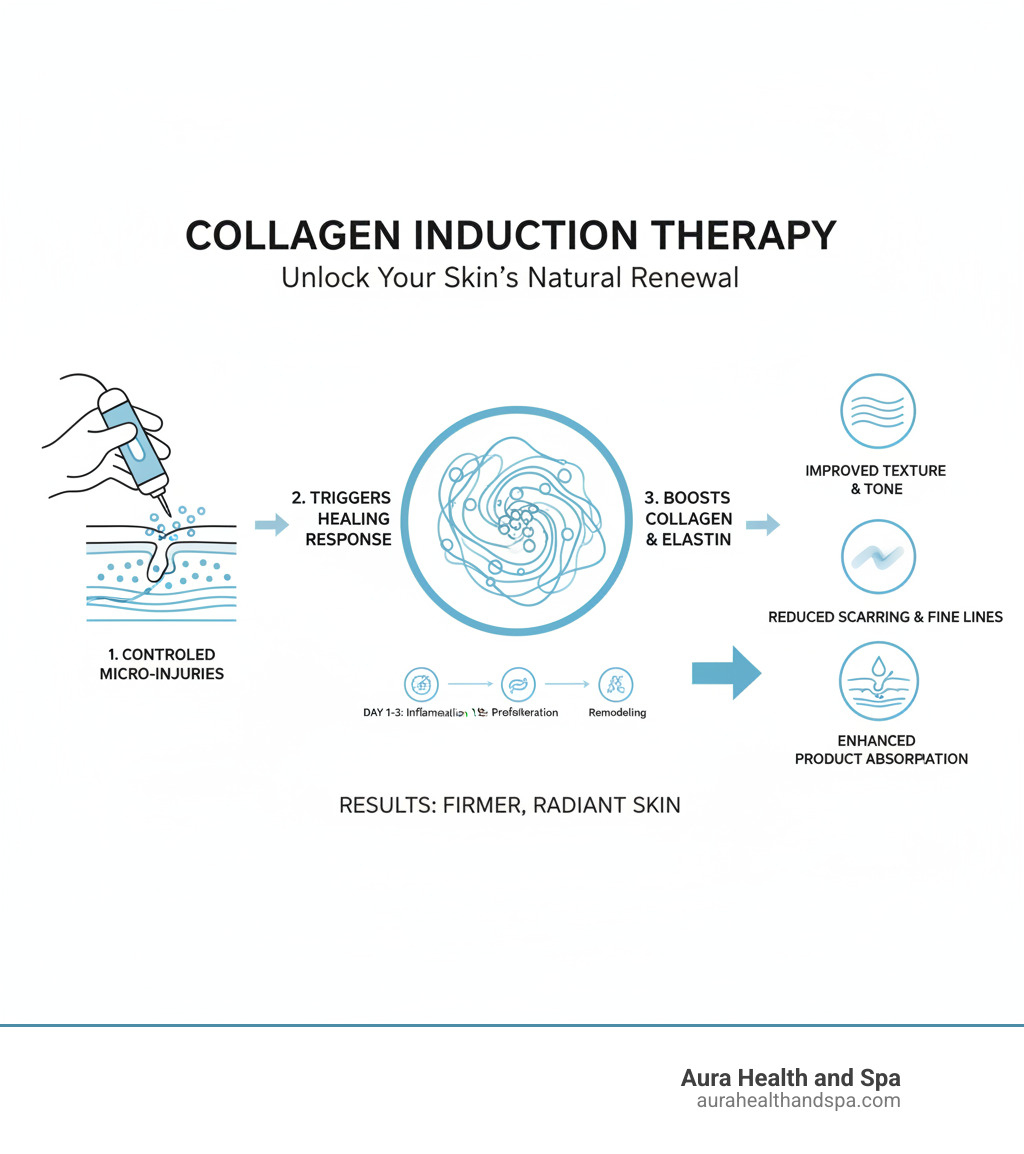
Collagen induction therapy acts as a wake-up call for your skin, reminding it to heal and rebuild. We use a specialized device, like the FDA-approved SkinPen, equipped with tiny, sterile needles. These needles create controlled micro-injuries on the skin’s surface.
Your body detects these micro-injuries and initiates a healing response. Blood flow increases, and skin cells begin producing collagen and elastin—the two proteins responsible for firm, smooth, and elastic skin. As we age, production of these proteins drops, leading to fine lines and sagging. By creating these micro-injuries, we trigger a surge in collagen and elastin that continues for weeks, gradually improving your skin’s texture and firmness.
These micro-channels also dramatically boost the absorption of serums and growth factors applied during treatment, increasing their effectiveness by up to 300%. This is why professional Collagen Induction Therapy delivers results that topical products alone cannot match. The process activates your body’s natural ability to regenerate, without adding foreign substances.
Advanced Microneedling: SkinPen and Regenerative Options
Not all microneedling is the same. At Aura Health & Spa, we use advanced technology for the best possible results.
Our foundation is the SkinPen, an FDA-approved device considered the industry’s gold standard. Its precision allows us to adjust needle depth for different skin concerns and treatment areas, ensuring safety and effectiveness. Each cartridge is single-use and sterile, eliminating any risk of cross-contamination.
For clients seeking improved results, we offer regenerative microneedling, which combines the SkinPen with powerful growth factors like PDGF (platelet-derived growth factor). These growth factors accelerate healing and amplify collagen production, leading to faster recovery and more dramatic improvements in skin tightening and texture.
Standard SkinPen Microneedling uses controlled micro-injuries to trigger natural collagen and elastin production. It’s perfect for treating fine lines, enlarged pores, mild scarring, and uneven texture, leading to smoother skin and a more even tone. This treatment is ideal for general rejuvenation and addressing mild to moderate concerns. Learn more about our SkinPen Microneedling treatment.
Regenerative SkinPen Microneedling with Growth Factors improves the treatment by applying advanced growth factors after creating micro-channels. These messengers accelerate healing, boost collagen synthesis, and promote faster skin repair. This results in more pronounced rejuvenation and superior improvement in deeper scars and skin firmness. This option is perfect for significant signs of aging or stubborn acne scars. Find our Regenerative SkinPen Microneedling + PDGF Topical treatment.
During your consultation, we’ll assess your skin and recommend the best option to meet your goals, ensuring personalized care that delivers visible results.
When searching for “collagen induction therapy near me,” you’re likely hoping to address a specific skin concern. The great thing about microneedling is that it addresses many issues in one treatment.
- Fine lines and wrinkles: By stimulating fresh collagen, microneedling naturally plumps the skin from within, smoothing lines around the eyes, forehead, and mouth.
- Acne and surgical scars: The treatment breaks down old scar tissue and encourages the growth of new, healthy cells, improving texture and depth.
- Enlarged pores: As collagen production increases, the skin tightens, causing pores to appear smaller and more refined.
- Hyperpigmentation and sun damage: Microneedling promotes cell turnover, helping to fade dark spots and reveal a more even, luminous complexion.
- Overall skin quality: It refines rough texture, restores firmness, and brings back a healthy glow. It can even improve the appearance of stretch marks.
A major advantage is that microneedling is safe for all skin types. Unlike some heat-based laser treatments that risk pigmentation changes in darker skin, microneedling works mechanically, making it a reliable choice for everyone. At Aura Health & Spa, we’ve seen clients regain confidence after completing their treatment series.
See the Real Results
Real results matter more than promises. The images below show genuine changes from microneedling treatments.
Notice how the depth and texture of acne scarring soften dramatically. The skin becomes smoother and more even as the collagen remodeling process works.
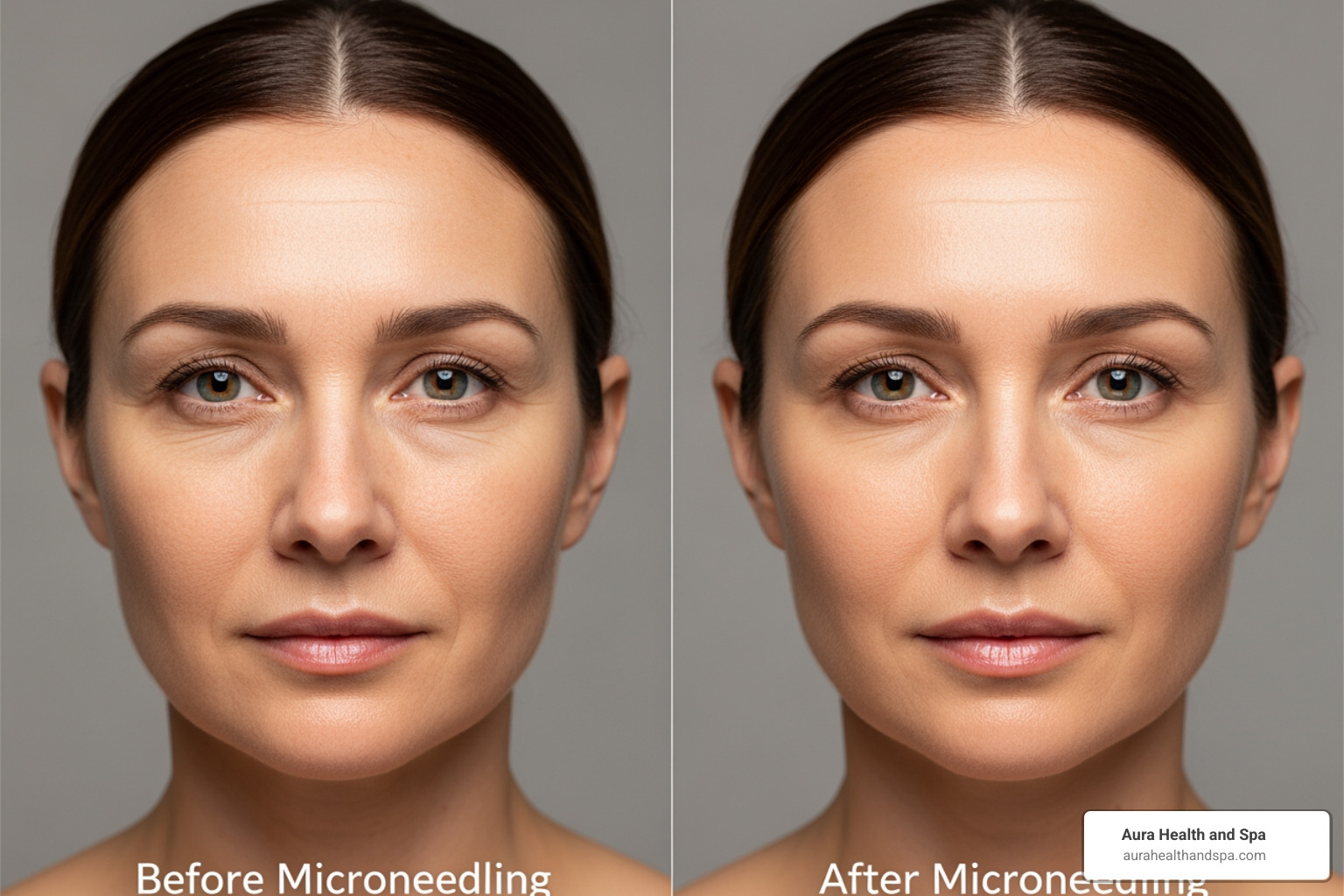
Fine lines around the eyes and forehead diminish as new collagen fills in creases, creating a plumper, smoother look without appearing artificial.
Even stretch marks show significant improvement. The texture softens and the color fades, giving the skin a more uniform appearance.
These are honest examples of what happens when you give your skin the tools to heal itself. We’ll discuss what you can realistically expect during your consultation.
Your Microneedling Journey: From Consultation to Recovery
Starting your microneedling journey at Aura Health & Spa means personalized care at every step. Whether exploring our Facial Treatments or focusing on collagen induction therapy near me, we guide you toward your desired results.
What to Expect During a Microneedling Treatment
Your first visit begins with a professional consultation to discuss your skin concerns, review your medical history, and ensure microneedling is right for you. We’ll create a customized treatment plan, including the likely number of sessions needed.
Here’s what happens during the treatment itself:
- Cleansing: We thoroughly cleanse your skin to create a sterile surface.
- Numbing: A topical numbing cream is applied for 20-30 minutes to ensure your comfort. Most clients report only a mild, prickly sensation during the procedure.
- Treatment: Our practitioner gently guides the SkinPen device across your skin. The treatment itself takes 30-60 minutes, depending on the area size.
- Serum Application: Immediately after, we apply a hydrating or regenerative serum. The new micro-channels allow these ingredients to penetrate deeply for maximum benefit.
- Aftercare Instructions: Before you leave, we provide detailed aftercare instructions so you know how to protect your skin and optimize your results.
The entire appointment typically lasts one to two hours. Your comfort and care are our top priorities.
The Recovery Process and Seeing Your Results
One of the best things about microneedling is the minimal downtime. Immediately after your session, your skin will look bright red, similar to a moderate sunburn. This is a normal sign that the healing response has been activated and typically fades within a few days. You may also experience mild swelling and tenderness for a day or two. Some light flaking or peeling can occur as your skin regenerates, usually resolving within a week.
During recovery, avoid direct sun for at least 48 hours and use a broad-spectrum SPF consistently for two weeks. We also recommend skipping makeup and intense workouts for 24 hours.
So, when will you see results? Many clients notice an immediate glow. However, the most significant changes appear gradually. As new collagen and elastin build, you’ll see continued improvement in texture and firmness. The most dramatic results are typically visible four to six weeks after each session. According to scientific research, skin can continue improving for up to six months as collagen remodeling progresses.
Most clients need a series of three to six sessions, spaced four to six weeks apart, for optimal and lasting change. Your personalized plan will outline exactly what to expect.
Elevating Your Results: Advanced Collagen Induction Therapy Near Me
While microneedling is effective on its own, combining it with other therapies can amplify your results. At Aura Health & Spa, we create custom treatment plans to address your specific goals. We also offer complementary treatments like Botox and Dermal Fillers that work well with microneedling.
Microneedling with PRP (Platelet-Rich Plasma)
Often called the “Vampire Facial,” this treatment uses your body’s own healing power through Platelet-Rich Plasma, or PRP. We draw a small amount of your blood and spin it in a centrifuge to isolate the platelet-rich plasma, a golden liquid packed with growth factors.
This PRP is applied to your skin immediately after microneedling. The micro-channels allow these potent growth factors to penetrate deeply, accelerating healing, boosting collagen production, and promoting robust new skin cell regeneration. The result is faster, more dramatic improvements in texture and tone. Since it uses your own blood, there is zero risk of an allergic reaction.
Microneedling with Growth Factors like PDGF
Another powerful option is combining microneedling with advanced topical growth factors like Platelet-Derived Growth Factor, or PDGF. These messengers signal your skin cells to ramp up repair and rejuvenation.
When applied after microneedling, PDGF reaches the deeper layers of your skin, resulting in boosted collagen synthesis, faster skin repair with less downtime, and improved cellular regeneration. Our Regenerative SkinPen Microneedling + PDGF Topical treatment is particularly effective for significant concerns like deep acne scars and advanced signs of aging. If you want optimal skin repair and faster results, this combination may be the perfect solution.
Is Microneedling Right for You? Key Considerations
It’s smart to ask if collagen induction therapy near me is the right fit for your skin. Understanding the ideal candidate, risks, and cost will help you make a confident decision. At Aura Health & Spa, we prioritize honest conversations. If you have questions, Contact Us anytime.
Who is a Good Candidate for collagen induction therapy near me?
Microneedling is remarkably versatile. You are likely an ideal candidate if you want to improve your skin’s appearance without surgery and are dealing with:
- Fine lines and wrinkles
- Acne scars, surgical scars, or stretch marks
- Enlarged pores
- Hyperpigmentation and sun damage
- Loss of skin firmness or uneven texture
One of the treatment’s best features is that it’s safe for all skin tones. Unlike some lasers, it doesn’t use heat, making it a reliable choice for everyone. If you’re seeking a non-surgical way to refresh your appearance with gradual, natural-looking results, microneedling could be perfect for you.
Risks, Contraindications, and Cost of collagen induction therapy near me
While microneedling is safe when performed by a trained professional, it’s important to know what to expect.
Common side effects are temporary and include redness, mild swelling, and a sunburn-like sensation that fades within a few days. Some clients experience minor bruising, dryness, or light peeling for up to a week. These are normal signs of healing.
Rare risks include skin infection (we follow strict sterile protocols to minimize this) or temporary pigmentation changes, especially if sun protection is ignored.
Microneedling is not recommended if you:
- Are pregnant or breastfeeding.
- Have active acne, cold sores, or other skin infections in the treatment area.
- Have chronic skin conditions like eczema, psoriasis, or rosacea in the area.
- Have recently taken Accutane (isotretinoin).
- Have a history of keloid scarring.
Let’s talk about cost. The price of collagen induction therapy near me varies, but industry-wide, sessions typically range from $250 to $800. At Aura Health & Spa, our microneedling sessions start at around $325, and we offer package deals to make a series more affordable. During your consultation, we provide a clear breakdown of your personalized treatment plan’s cost with no hidden fees.
Frequently Asked Questions about Collagen Induction Therapy
Here are answers to some of the most common questions we receive about collagen induction therapy near me at Aura Health & Spa.
Does microneedling hurt?
Your comfort is our priority. Before the session, we apply a high-quality topical numbing cream that significantly reduces sensation. Most patients describe the feeling as a mild, warm, prickly sensation. Discomfort is minimal, and any post-treatment sensitivity usually subsides within hours. We ensure all treatments are performed in a comfortable, safe, and sterile environment.
What’s the difference between professional microneedling and at-home rollers?
The differences are significant and center on safety and effectiveness.
- Safety and Sterility: Professional devices like our FDA-approved SkinPen use sterile, single-use cartridges. At-home rollers are difficult to sterilize, increasing the risk of infection.
- Needle Depth and Precision: Professional devices have adjustable needle depths to safely target specific concerns. At-home rollers have fixed, often blunt needles that can tear the skin, causing scarring and uneven results.
- Effectiveness: Professional microneedling penetrates deeply enough to stimulate collagen production. At-home rollers offer superficial exfoliation at best and do not achieve true collagen induction.
- Risk of Damage: Without proper training, at-home rollers can cause inflammation and permanent damage. A qualified practitioner performs the treatment safely and manages any side effects.
For these reasons, we strongly recommend choosing a qualified facility for your treatment.
How many microneedling sessions are usually needed?
The number of sessions depends on your skin concerns and goals.
- Typical Series: Most clients benefit from a series of 3 to 6 sessions.
- Spacing: Sessions are typically spaced 4 to 6 weeks apart to allow for proper healing and collagen remodeling.
- For Best Results: More significant concerns like deep acne scars may require 4-6 sessions, while general rejuvenation may only need 2-3.
- Maintenance: To prolong the benefits, maintenance sessions are recommended every 6 to 12 months.
We will develop a personalized treatment plan during your initial consultation.
Start Your Journey to Refreshed Skin
You’ve learned about the science, process, and benefits of collagen induction therapy near me. Now, it’s time to take the next step toward the radiant skin you deserve.
At Aura Health & Spa, we are passionate about helping you look younger and feel more confident. As Metro Detroit’s trusted destination for medical aesthetics, our reputation is built on precision, professionalism, and visible results. We create personalized plans that work with your body’s natural healing abilities to deliver real, lasting improvements.
Microneedling is a partnership between your skin’s regenerative power and our expertise. By stimulating collagen, we help your skin naturally restore its youthful texture, firmness, and glow. Whether you’re addressing acne scars, fine lines, or uneven tone, it offers a safe, effective solution with minimal downtime.
Our team prioritizes transparency, safety, and education. During your consultation, we’ll answer your questions honestly and create a treatment plan customized to your goals—no pressure, just expert guidance.
Ready to reveal smoother, firmer, and more radiant skin? Book your expert Collagen Induction Therapy consultation today at Aura Health & Spa. Whether you’re in Plymouth, Sterling Heights, Ann Arbor, or anywhere across Michigan, we’re here to help you find the transformative power of microneedling.
Because at Aura Health & Spa, confidence truly starts with results you can see.
by Dr. Reema Sethi | Nov 13, 2025 | Skincare
Understanding Collagen Induction Therapy: A Natural Path to Skin Renewal
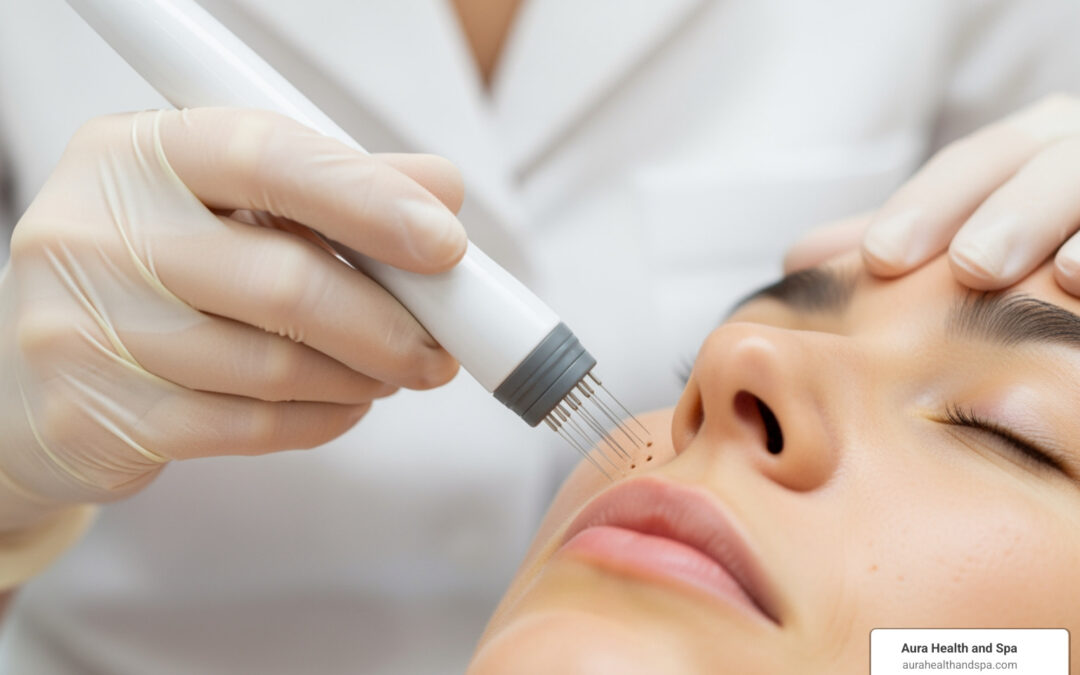
Collagen induction therapy is a minimally invasive cosmetic procedure that uses tiny, sterile needles to create controlled micro-injuries in your skin. These micro-injuries trigger your body’s natural healing process, stimulating the production of collagen and elastin – the essential proteins that keep your skin firm, smooth, and youthful.
Quick Answer: What You Need to Know
- What it is: A procedure using fine needles to puncture the skin and stimulate natural healing
- Also known as: Microneedling, dermarolling, skin needling, or percutaneous collagen induction
- How it works: Creates controlled micro-injuries that trigger collagen and elastin production
- What it treats: Acne scars, fine lines, wrinkles, hyperpigmentation, stretch marks, and hair loss
- Key benefits: Improved skin texture, reduced scarring, brighter tone, minimal downtime
- Recovery time: Typically 24-48 hours of mild redness and sensitivity
This treatment has become one of the most popular options in aesthetic medicine because it harnesses your body’s own healing abilities. Unlike ablative procedures that destroy the epidermis, collagen induction therapy preserves your skin’s protective outer layer while working beneath the surface to create real, lasting change.
Research shows impressive results. Studies found that patients experienced a 400% increase in collagen and elastin deposition six months after treatment. The epidermis itself thickened by 40% within a year. These aren’t just superficial improvements – they represent genuine regeneration of your skin’s structure.
Why This Matters for Your Wellness Journey
Your skin is more than just a physical barrier. It reflects your inner vitality and energy. When your skin feels healthy and radiant, it affects your confidence, your presence, and how you move through the world. Collagen induction therapy offers a way to support your skin’s natural renewal process without harsh chemicals or invasive surgery.
I’m Dr. Reema Sethi, a board-certified emergency medicine physician with over 15 years of clinical experience. After training in medical aesthetics in Chicago, I now specialize in delivering safe, effective collagen induction therapy treatments at Aura Health and Spa in Plymouth, Michigan, where I combine my medical expertise with a holistic approach to help you achieve your most radiant self.
The Science Behind Collagen Induction Therapy: How It Refreshs Your Skin
Your skin has an amazing superpower: it knows exactly how to heal itself. Every time you get a paper cut or scrape your knee, your body launches into action without you having to think about it. Collagen induction therapy harnesses this incredible natural ability, giving your skin the signal it needs to refresh and renew itself from the inside out.
What is Collagen Induction Therapy (CIT)?
Collagen induction therapy is a minimally invasive dermatological procedure that’s been gaining popularity for good reason. You might know it better as microneedling, though it goes by several names including percutaneous collagen induction (PCI), dermarolling, or simply skin needling. Whatever you call it, the principle remains the same: using very fine, sterile needles to create controlled micro-injuries in your skin.
I know what you’re thinking. “Injuries? That doesn’t sound relaxing!” But here’s the beautiful part: these aren’t the kind of injuries that cause damage. They’re precise, microscopic channels that wake up your skin’s natural healing abilities without requiring surgery or extensive downtime. It’s like sending your skin a gentle wake-up call to start producing fresh, healthy tissue.
This approach has become one of the most sought-after treatments in aesthetic medicine because it works with your body’s natural processes, not against them. Rather than forcing change with harsh chemicals or invasive procedures, we’re simply encouraging your skin to do what it already does best: heal and regenerate.
The Skin’s Natural Healing Mechanism
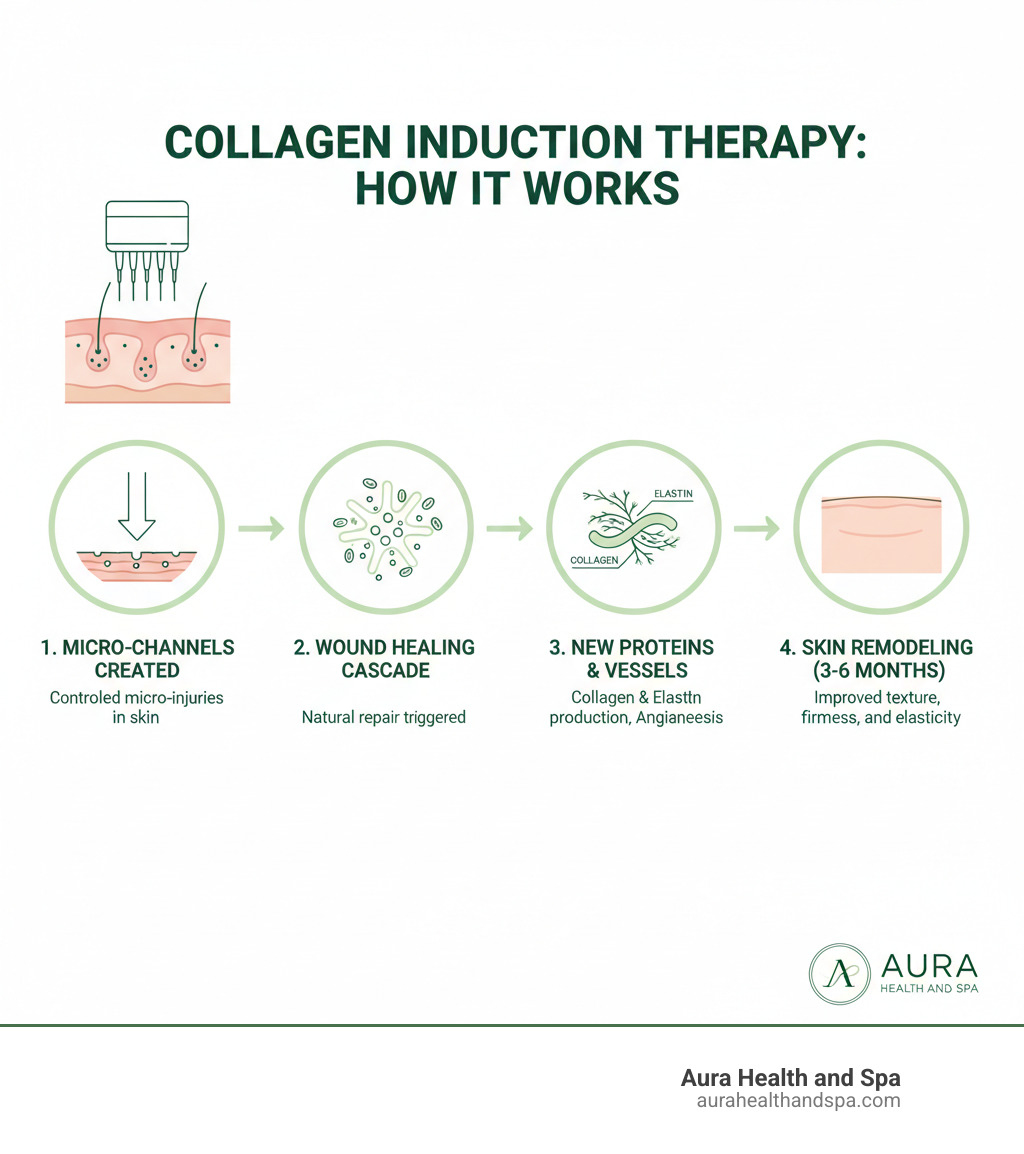
When we perform collagen induction therapy at Aura Health and Spa, we’re essentially starting a conversation with your skin. Those controlled micro-injuries we create? They’re the opening line. Your skin responds immediately, launching what we call the wound healing cascade.
This healing process unfolds in three distinct phases. First comes the inflammation phase, which starts almost instantly. Your body recognizes those tiny channels and sends blood rushing to the area, bringing immune cells along for the ride. This is why your skin might look a bit pink right after treatment. Don’t worry—that rosy glow is actually a sign that everything’s working perfectly.
Next, the proliferation phase begins. This is where the real magic happens. Your body releases growth factors that tell your fibroblasts—the cells responsible for making collagen—to get busy. New skin cells start multiplying, fresh blood vessels form, and most importantly, your skin begins producing collagen and elastin. These are the proteins that keep your skin firm, smooth, and youthful.
Finally, the remodeling phase takes over. This continues for weeks and even months after your treatment. The new collagen and elastin mature and organize themselves, strengthening your skin’s structure from within. It’s like renovating a house with better materials—the foundation becomes stronger, and the results last.
The science behind this is solid. Scientific research on new collagen formation has shown remarkable improvements in treated skin. Studies found that patients experienced increased collagen and elastin deposition as early as six months after treatment. Even more impressive, the epidermis—your skin’s outer protective layer—thickened by about 40 percent within a year, with the stratum spinosum showing particularly strong improvements.
These aren’t just surface-level changes. Your skin is genuinely becoming healthier, stronger, and more resilient. The epidermal thickening means better protection against environmental stressors, while the increased collagen deposition translates to smoother texture and improved elasticity. It’s regeneration in the truest sense of the word.
Opening Up Your Skin’s Potential: Applications and Benefits
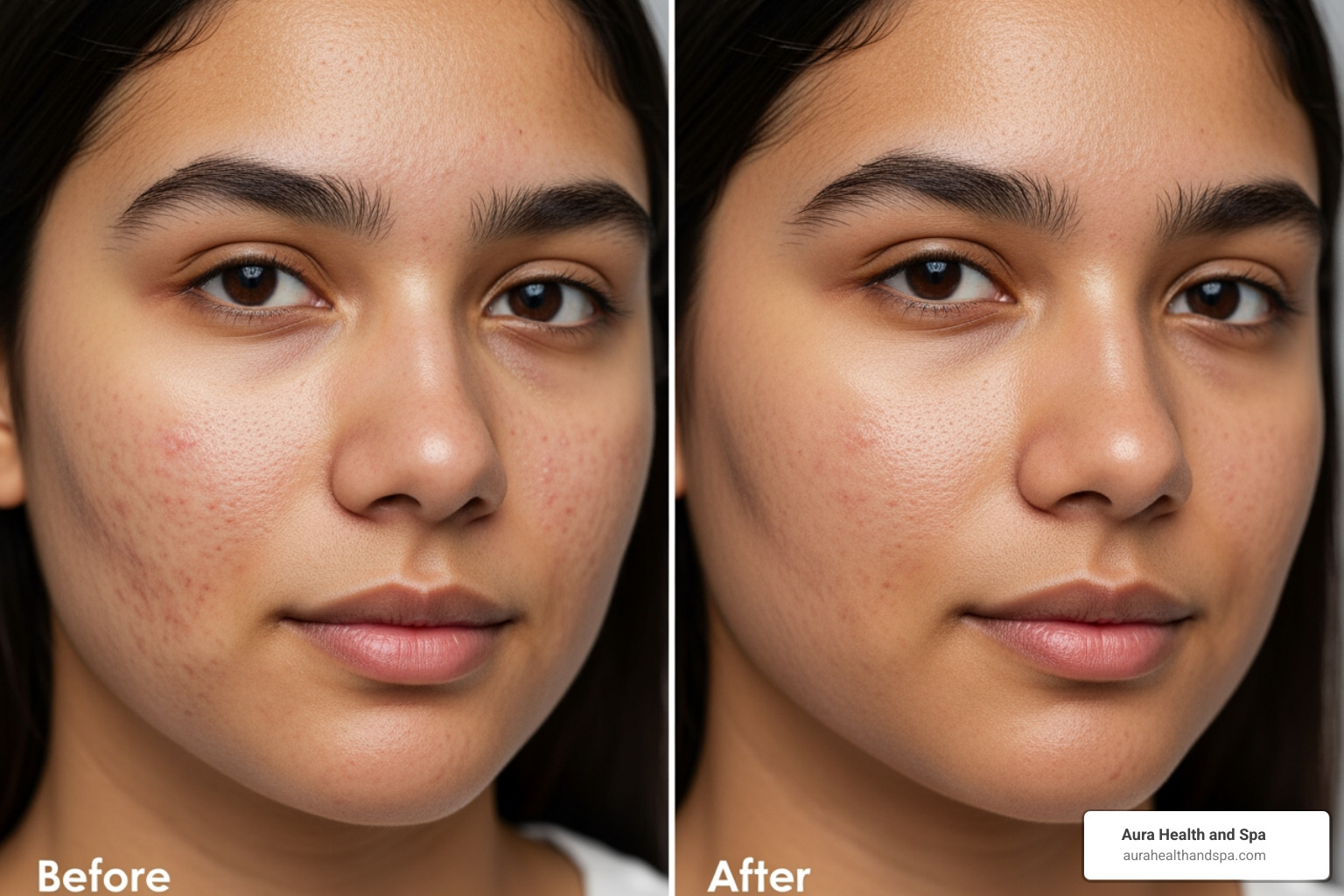
Your skin tells a story. Sometimes it’s a story of sun-soaked summers, other times it’s chapters written by acne, stress, or simply the passage of time. Whatever your skin’s journey has been, collagen induction therapy offers a way to help rewrite those chapters you’d like to change.
I’ve watched countless clients walk through our doors in Plymouth, Sterling Heights, and Ann Arbor feeling self-conscious about their skin. They leave with renewed confidence, not because we’ve performed magic, but because we’ve helped their own bodies open up their natural healing potential.
Key Conditions Treated with CIT
When clients ask me what collagen induction therapy can address, I’m always excited to share just how versatile this treatment truly is. The beauty of CIT lies in its ability to tackle so many different concerns through one fundamental mechanism – stimulating your body’s own collagen production.
Atrophic acne scars are perhaps one of the most common reasons people seek out microneedling. These are the depressed, pitted scars that severe acne leaves behind. Research shows that after just two sessions, patients notice mild improvement, and after six sessions, many see moderate to good improvement in their scar appearance. By rebuilding collagen in these sunken areas, we’re literally filling in the gaps from the inside out.
Fine lines and wrinkles respond beautifully to this treatment as well. As collagen and elastin naturally decline with age, our skin loses that plump, youthful quality. CIT reverses this process by jumpstarting fresh collagen production. The delicate lines around your upper lip, those crow’s feet by your eyes – these all soften as your skin rebuilds itself.
For those struggling with hyperpigmentation and sun spots, the results can be truly liberating. The treatment helps break up clusters of excess pigment while encouraging new, evenly toned skin cells to take their place. When we combine CIT with targeted topical agents like tranexamic acid or vitamin C, the improvement in conditions like melasma becomes even more dramatic.
Stretch marks – medically known as striae distensae – are another area where we’ve seen remarkable changes. Whether they appeared after pregnancy, growth spurts, or weight changes, these silvery lines represent areas where collagen and elastin broke down. One fascinating study found that microneedling effectively improved stretch marks on both the thighs and abdominal area when combined with appropriate fillers.
Even enlarged pores respond to treatment. By promoting collagen production around each pore, the skin tightens, making pores appear smaller and less noticeable. It’s like tightening the weave of a fabric.
What surprises many people is that hair loss, particularly androgenetic alopecia, can also be addressed with microneedling. Studies suggest it activates stem cells and dermal papillae, triggering the production of epidermal growth factors essential for healthy hair follicles. When combined with minoxidil or Platelet-Rich Plasma (PRP), the results become even more impressive.
You can find more info about SkinPen Microneedling and how it specifically addresses these concerns on our website.
Beyond treating specific conditions, collagen induction therapy creates a ripple effect of positive changes throughout your skin. It’s not just about fixing one problem – it’s about elevating your entire complexion.
Improved skin texture is often the first thing people notice. That rough, uneven feeling transforms into something smoother and more refined. Your makeup glides on better. Your skin simply feels better when you touch it.
Improved skin firmness and elasticity follow as your collagen and elastin networks rebuild. Your skin regains that youthful bounce and resilience it had years ago. It looks lifted, feels firmer, and moves more naturally with your expressions.
The reduced appearance of scars – whether from acne, surgery, or old injuries – happens gradually as healthy tissue replaces damaged areas. We’re not erasing your history, but we’re helping your skin tell a different story.
Many clients are thrilled by their brighter, more even skin tone. Discoloration fades. Dark spots lighten. The overall clarity improves, creating a luminous quality that no highlighter can replicate.
Perhaps most telling is the high patient satisfaction we see. In one study conducted in Germany, patients rated their improvement between 60 and 80 percent better than before treatment. These aren’t just numbers – they represent real people who feel more confident in their own skin.
And here’s what makes this all even better: you achieve these results with minimal downtime. Unlike more aggressive treatments that leave you hiding at home for weeks, CIT lets you return to your daily activities quickly. You might be a little red for a day or two, but that’s a small price for such remarkable change.
Want to explore even more ways this treatment can benefit your skin? Check out the lesser known microneedling benefits for radiant skin on our blog.
Exploring the Different Types of CIT and How They Compare
Just as there are many paths to wellness, there are several approaches to collagen induction therapy, each offering unique advantages. Understanding these options helps us create the perfect treatment plan custom to your individual skin goals and needs.
Manual vs. Automated Devices
The world of microneedling has evolved significantly, and today we have access to sophisticated tools that deliver precise, effective results.
Dermarollers were among the pioneers of modern microneedling. These handheld devices feature a rotating barrel studded with tiny needles. While they played an important role in bringing microneedling to the forefront, they have some limitations. The rolling motion can sometimes create uneven punctures or “track marks” on the skin. Additionally, because the needles enter at an angle rather than vertically, they can cause more trauma to the surrounding tissue. You’ve probably seen at-home dermarollers available for purchase, but these typically have much shorter needles that can’t penetrate deeply enough to reach the dermis where true collagen stimulation happens.
Dermapens, or automated microneedling devices, represent the modern gold standard for professional collagen induction therapy. These pen-like devices use disposable needle cartridges that move rapidly up and down, creating clean, vertical punctures in the skin. This vertical action is a game-changer because it creates more precise micro-channels while minimizing damage to the surrounding epidermis. The result? Faster healing, less discomfort, and more consistent, beautiful outcomes.
Professional devices like the SkinPen we use at Aura Health and Spa can adjust needle depth precisely to reach the dermis, the deeper skin layer where collagen production truly happens. This level of control and penetration simply isn’t possible with at-home devices. When you choose professional treatment, you’re also benefiting from our expertise in maintaining sterility, selecting the optimal needle depth for your specific concerns, and ensuring even application across the treatment area.
Advanced CIT: Microneedling with Radiofrequency (RF)
For those seeking even more dramatic results, microneedling with radiofrequency takes collagen induction therapy to an exciting new level. This advanced treatment combines the physical benefits of microneedling with the powerful thermal energy of radiofrequency technology.
Here’s how it works: as the microneedles create those beneficial micro-channels in your skin, radiofrequency energy is simultaneously delivered deep into the dermis. This controlled heat creates an additional stimulus for collagen and elastin production, amplifying the skin’s natural healing response. The thermal energy creates a broader zone of treatment around each needle point, intensifying the entire collagen-rebuilding process.
The benefits are truly impressive. RF microneedling offers improved collagen remodeling, superior skin tightening effects, and the ability to treat deeper tissue layers for more comprehensive rejuvenation. It’s particularly effective for addressing skin laxity, deeper wrinkles, and texture concerns that need that extra boost.
If this sounds intriguing, you can discover youthful skin with Microneedling and Radiofrequency on our blog. We’re proud to offer Morpheus8, a cutting-edge RF microneedling treatment that delivers remarkable results. Learn more info about Morpheus8 Skin Rejuvenation and see if it’s the right fit for your skin change journey.
CIT vs. Other Rejuvenation Treatments
When you’re exploring your options for skin rejuvenation, it’s helpful to understand how collagen induction therapy compares to other popular treatments. Let’s look at how CIT and laser therapy differ:
| Feature |
Collagen Induction Therapy (CIT) |
Laser Therapy |
| Invasiveness Level |
Minimally invasive; creates controlled micro-channels without removing skin layers |
Varies by type; can be non-ablative (no tissue removal) to ablative (removes outer skin layers) |
| Downtime/Recovery |
Minimal; typically 24-48 hours of redness and sensitivity, back to normal activities quickly |
Varies widely; ablative lasers may require 1-2 weeks of healing, non-ablative options have less downtime |
| Suitability for Skin Types |
Safe and effective for all skin types, including darker skin tones (Fitzpatrick IV-VI) |
Some lasers carry higher risk of hyperpigmentation in darker skin tones; careful selection required |
| Safety for Darker Skin Tones |
Excellent safety profile; no risk of thermal damage or pigmentation changes |
Requires caution; certain wavelengths can cause post-inflammatory hyperpigmentation in melanin-rich skin |
| Cost Comparison |
Generally more affordable per session; multiple sessions typically needed |
Can be more expensive; cost varies significantly by laser type and treatment area |
What makes collagen induction therapy particularly special is its universal safety profile. Because it works through mechanical stimulation rather than heat or light energy, it doesn’t carry the same risks for hyperpigmentation that can affect people with darker skin tones when using certain lasers. This makes CIT an inclusive option that delivers beautiful results for everyone, regardless of skin type.
Both CIT and laser therapy have their place in aesthetic medicine, and sometimes they can even complement each other. If you’re curious about laser options, you can explore The Professional Guide to Laser Skin Treatment Advantages to learn more. During your consultation at Aura Health and Spa, we’ll discuss which approach or combination of treatments will best help you achieve your unique skin goals.
by Dr. Reema Sethi | Nov 13, 2025 | Skincare
Why Liquid Facelifts Are Changing Facial Rejuvenation in Michigan
A liquid facelift Michigan offers a non-surgical path to a more youthful, refreshed appearance using strategic injections of dermal fillers and neurotoxins. Unlike traditional facelift surgery, this modern approach requires no incisions, no general anesthesia, and minimal downtime. This makes it the ideal solution for busy professionals across Metro Detroit who want to look as energetic and capable as they feel, without disrupting their demanding schedules.
Quick Facts About Liquid Facelifts in Michigan:
- What it is: A customized, non-surgical treatment combining injectable dermal fillers and neurotoxins to restore facial volume, smooth away wrinkles, and lift sagging areas for a comprehensive yet natural-looking rejuvenation.
- Procedure time: Typically 30-60 minutes, often referred to as a “lunchtime lift.”
- Downtime: Minimal to none; most patients can return to work and daily activities immediately.
- Results duration: Varies from 6 months to over 2 years, depending on the specific products used and the individual’s metabolism.
- Cost: Significantly lower than surgical facelift alternatives, offering an accessible entry point to facial rejuvenation.
- Best for: Adults showing mild to moderate signs of aging who desire natural-looking results and want to avoid the risks and recovery associated with surgery.
When you think of facial rejuvenation, surgery probably comes to mind first. But the aesthetic landscape has shifted. The truth is, nearly 75% of injectable treatments are now focused on rebuilding the facial framework and restoring volume, rather than simply chasing individual lines. By age 35, this underlying volume loss is the primary reason you start looking tired—even when you feel energetic and capable. A hollowed appearance can inadvertently project an image of fatigue or stress in a professional environment.
A liquid facelift directly addresses this by strategically replacing lost volume in key areas like the cheeks, temples, and under-eyes, while simultaneously smoothing dynamic wrinkles on the forehead and around the eyes. The result? A refreshed, revitalized version of yourself that colleagues and friends notice, but can’t quite pinpoint.
I’m Dr. Reema Sethi, a board-certified Emergency Medicine physician who transitioned into medical aesthetics after more than 15 years in emergency care. My experience in a high-stakes medical environment honed my ability to perform delicate procedures with extreme precision, anatomical expertise, and a calm, steady hand—skills that are paramount in medical aesthetics. After training in Chicago, I now bring this commitment to precision and safety to every liquid facelift Michigan treatment at Aura Health and Spa. I develop individualized plans that deliver subtle, effective results for busy professionals across Metro Detroit, helping them regain a look that truly reflects their inner vitality.
What is a Liquid Facelift? A Deep Dive into the “Lunchtime Lift”
Picture this: You slip away during your lunch break for a quiet, comfortable appointment. In less than an hour, the treatment is complete, and you return to the office looking noticeably refreshed and more vibrant—without any tell-tale signs of surgery and without anyone being able to pinpoint exactly what changed. That’s the transformative beauty of a liquid facelift Michigan.
This advanced, non-surgical approach to facial rejuvenation has earned its “lunchtime lift” nickname for good reason. Most treatments take less than an hour, and you can literally schedule one between meetings. There’s no operating room, no general anesthesia, and no need to spend a week or more hiding at home with bandages and ice packs. It’s rejuvenation that fits seamlessly into your life.
Instead of scalpels and sutures, we use a strategic and artful combination of injectable products to restore lost volume, smooth deep-set wrinkles, and gently lift sagging areas. The technique focuses on adding volume back where it’s been lost due to aging—your cheeks, temples, under-eyes, and along the jawline—rather than pulling the skin tight. This foundational approach creates a naturally refreshed version of yourself, not a different person entirely.
What makes this approach so effective? It addresses the real culprit behind an aging appearance: volume loss. When we replace that missing volume with dermal fillers and relax overactive muscles with neurotoxins, we are essentially rebuilding the structural support of a youthful face. The result is softer wrinkles, lifted contours, and a rested, healthy appearance that might just have colleagues asking if you’ve been on a relaxing vacation.
How It Works: Restoring Volume, Not Just Tightening Skin
Here’s what’s really happening when you look in the mirror and feel like you suddenly look tired all the time: your face is losing its underlying structure.
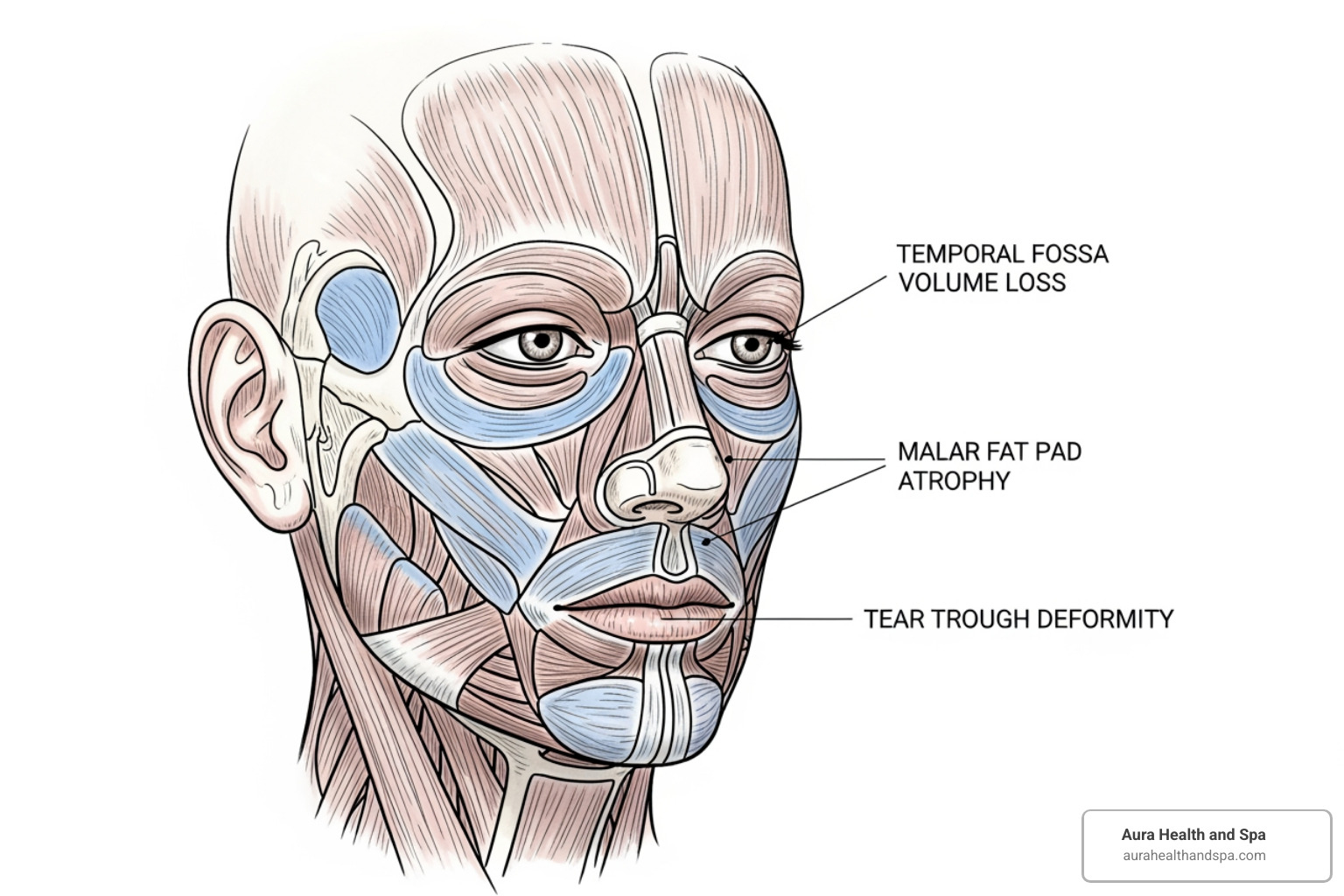
As we age, our bodies naturally produce less collagen and elastin—the essential proteins that keep skin plump, firm, and elastic. At the same time, the fat pads in our face begin to shrink and descend, and even the bones of the facial skeleton gradually recede. This structural loss, combined with the relentless pull of gravity, creates hollowed cheeks, sunken temples, prominent under-eye circles, and the formation of sagging jowls.
By the time most people reach their mid-30s, this volume loss becomes the primary reason they feel they look exhausted, even after a full night’s sleep. In fact, nearly 75% of the injectable treatments we perform at Aura Health & Spa focus specifically on rebuilding this facial framework and restoring that lost volume.
A liquid facelift Michigan works by precisely filling these “empty spaces” within your skin’s layers using advanced dermal fillers. Most modern dermal fillers are composed of a substance called Hyaluronic Acid (HA), a sugar molecule that occurs naturally in your skin and has a remarkable ability to attract and hold moisture. When injected, these smooth gels integrate seamlessly with your tissue to restore volume and structure. Some products, known as biostimulators, go a step further by stimulating your body’s own collagen production, helping to rebuild the foundation from within for longer-lasting results.
Think of it like renovating a house. If the foundation is sinking, you don’t just repaint the exterior and hope for the best. You shore up the structure first. That’s exactly what we’re doing with your face—restoring the framework so everything above it naturally lifts and smooths. The result? A gentle lift, softer lines, and a rested appearance that looks completely like you, just better.
Surgical vs. Non-Surgical: Key Differences
When you’re considering facial rejuvenation options, understanding how a liquid facelift compares to traditional surgery is crucial for making the right choice for your goals, lifestyle, and budget.
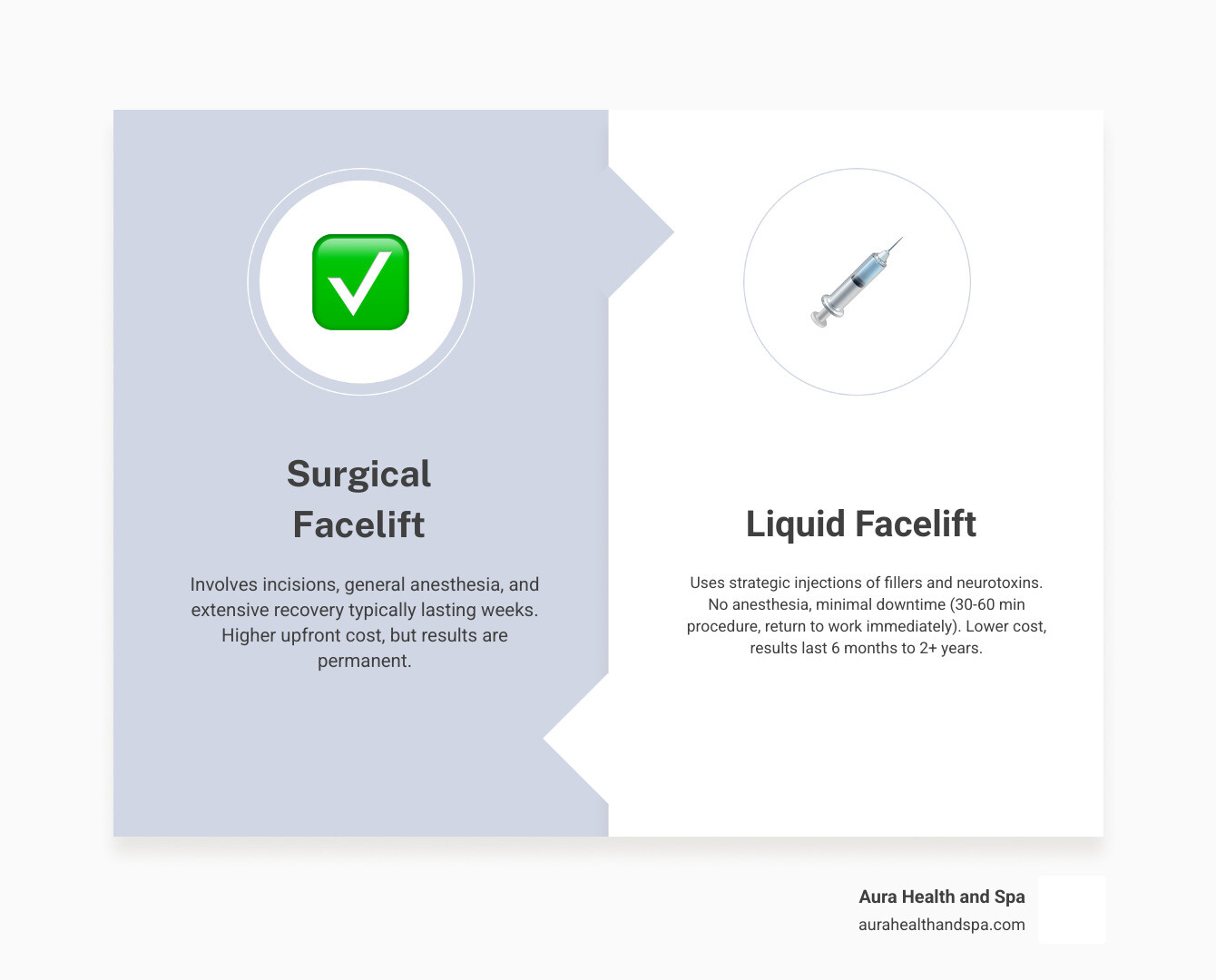
Both approaches aim to turn back the clock, but they get there via very different paths. A surgical facelift is an invasive procedure involving incisions, general anesthesia, and physically repositioning skin and underlying muscle. A liquid facelift, in contrast, uses a series of precise injections to restore volume and smooth wrinkles—no cutting, no stitches, and no hospital stay required.
| Criteria |
Liquid Facelift |
Surgical Facelift |
| Procedure Type |
Injectable treatments (fillers & neurotoxins) |
Invasive surgery with incisions |
| Invasiveness |
Non-surgical, minimally invasive (needle-based) |
Requires general anesthesia and incisions |
| Downtime |
Minimal—most return to work same day |
1-3 weeks of visible recovery, plus activity restrictions |
| Cost |
$2,000-$5,000 typically (varies by treatment plan) |
$10,000-$25,000+ |
| Results Longevity |
6 months to 2+ years (requires maintenance) |
7-10 years, though natural aging continues |
| Best For |
Mild to moderate aging, volume loss, busy lifestyles |
Severe sagging, significant excess skin, dramatic change |
The biggest advantage of a liquid facelift is the combination of significant, visible improvement with unparalleled convenience. You can walk in during your lunch hour and walk out looking refreshed enough that people notice your glow—but subtle enough that they can’t tell you had “work done.” There’s no lengthy, painful recovery, none of the risks associated with general anesthesia, and the financial investment is a fraction of what surgery costs.
That said, a liquid facelift is most effective for those with mild to moderate signs of aging. If you have significant skin laxity or very advanced sagging, a surgical approach might be more appropriate to achieve your goals. During your consultation at Aura Health & Spa, we’ll provide a thorough and honest assessment, guiding you toward the treatment that will actually deliver the results you’re hoping for.
Who is an Ideal Candidate for a Liquid Facelift in Michigan?
Not everyone needs—or wants—surgical intervention to look refreshed and youthful. A liquid facelift Michigan is particularly well-suited for a specific profile of individuals who value natural results and minimal disruption to their lives.
You’re likely an excellent candidate if you’re noticing mild to moderate signs of aging. This includes concerns like softening of the jawline, hollowing in the cheeks or temples, deepening smile lines (nasolabial folds), or a perpetually tired look around the eyes. Most of our liquid facelift patients are in their 30s through 50s, though we have successfully treated patients outside that range who fit the criteria.
Perhaps you’re simply not ready for surgery, either mentally or physically. The idea of going under the knife, the associated risks, and the required downtime may not align with your comfort level or lifestyle. Many people prefer a gradual, customizable approach that they can adjust over time, rather than committing to a single, permanent, and dramatic procedure.
Realistic expectations are tremendously important. A liquid facelift delivers beautiful, natural-looking rejuvenation by restoring youthful contours and softening shadows. It excels at making you look rested, vibrant, and like a younger version of yourself. However, it will not replicate the dramatic lifting power of surgery or remove large amounts of loose skin. If your goal is to look refreshed and revitalized, you’ll be thrilled. We will have an honest conversation during your consultation about what is realistically achievable.
Finally, ideal candidates should be in good overall health, without active skin infections, uncontrolled autoimmune diseases, or known allergies to the product components. A commitment to a healthy lifestyle, including sun protection and a good skincare regimen, will also help protect your investment and improve your results. During your comprehensive consultation at Aura Health & Spa, we’ll review your medical history and aesthetic goals to create a personalized plan that delivers the results you’re looking for—safely and effectively.
by Dr. Reema Sethi | Nov 13, 2025 | Skincare
Understanding Your Options for Youthful, Radiant Skin
Facial rejuvenation treatment encompasses a wide range of procedures designed to restore a more youthful appearance by addressing visible signs of aging like wrinkles, volume loss, and sagging skin. These treatments can be surgical or non-surgical, with most modern approaches focusing on minimally invasive techniques that deliver natural-looking results with little to no downtime.
Key facial rejuvenation options include:
- Injectables – Neuromodulators (Botox) and dermal fillers (hyaluronic acid) to smooth wrinkles and restore volume
- Skin resurfacing – Chemical peels, microdermabrasion, and laser treatments to improve texture and tone
- Collagen stimulation – Microneedling, radiofrequency (RF), and IPL to tighten and refresh skin
- Regenerative treatments – PRP (platelet-rich plasma) and Sculptra to naturally boost collagen production
- Combination approaches – Personalized treatment plans that address multiple concerns simultaneously
The demand for these treatments is growing rapidly, with millions of minimally invasive procedures like Botox and hyaluronic acid fillers performed annually in the U.S. alone.
Your skin changes over time due to internal factors like genetics and external factors like sun exposure. As you age, your body produces less collagen, elastin, and hyaluronic acid—the key substances that keep skin firm and smooth. This leads to common signs of aging like hollowed cheeks, jowls, and loss of facial definition.
The good news? Modern facial rejuvenation treatments can address these changes at multiple levels, helping you look like a refreshed, more youthful version of yourself.
I’m Dr. Reema Sethi, a board-certified emergency medicine physician with over 15 years of clinical experience who has specialized training in medical aesthetics from Chicago. At Aura Health and Spa, I apply my medical expertise to deliver safe, effective facial rejuvenation treatment plans custom to each patient’s unique goals and skin needs.
The Science of Facial Aging: Why Our Skin Changes
Understanding why your skin changes is the first step toward choosing the right facial rejuvenation treatment to help you look as vibrant as you feel. Facial aging is caused by a combination of internal and external factors.
Intrinsic aging is the natural process driven by genetics and your body’s biological clock. Around your mid-thirties, production of collagen (for firmness), elastin (for elasticity), and hyaluronic acid (for moisture) begins to decline. Cell regeneration slows, and hormonal shifts, especially during menopause, can make skin thinner and drier.
Extrinsic aging is caused by external factors. The primary culprit is sun exposure (photoaging), which damages skin cell DNA and accelerates collagen breakdown. Other factors include smoking, pollution, poor diet, and stress, all of which contribute to premature wrinkles, dark spots, and rough texture.
These combined aging processes lead to several visible changes:
- Wrinkles: Dynamic lines (like crow’s feet) appear with movement, while static lines (like nasolabial folds) become permanently etched into the skin.
- Volume Loss: Subcutaneous fat pads shrink and migrate downward, causing hollowed cheeks, sunken temples, and a deflated appearance.
- Sagging Skin and Jowls: As collagen and elastin degrade, skin loses its support structure, leading to sagging along the jawline and neck.
- Pigmentation and Texture Changes: Sun exposure often causes age spots and uneven tone, while slowed cell turnover leads to a rougher texture and more noticeable pores.
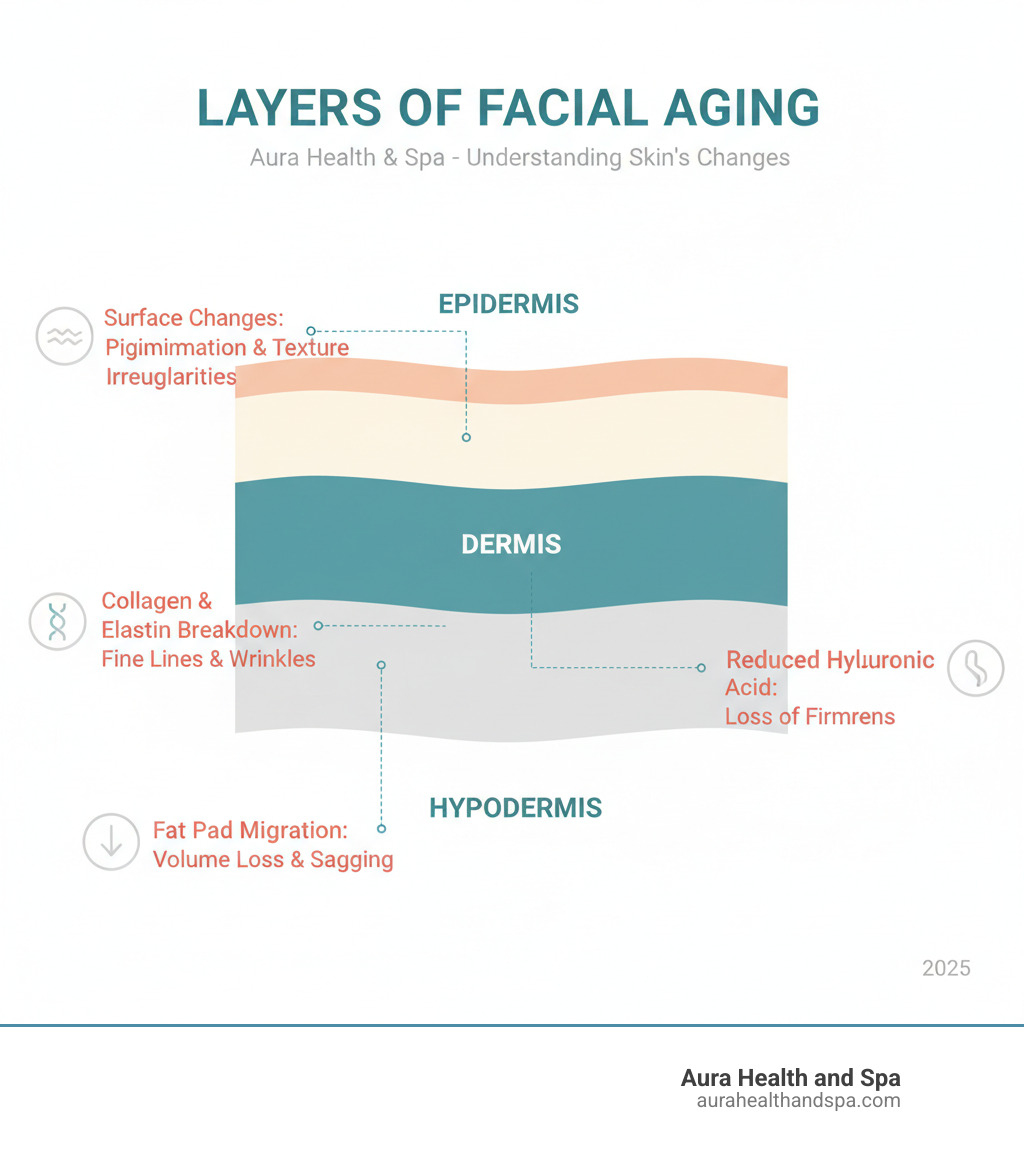
Beneath the surface, the changes are structural. In the dermis (the skin’s middle layer), collagen and elastin fibers degrade, losing their supportive function. At the same time, facial fat compartments shrink and shift downward. Understanding these structural changes is key to seeing why modern facial rejuvenation treatment options are designed to work on multiple levels of the skin.
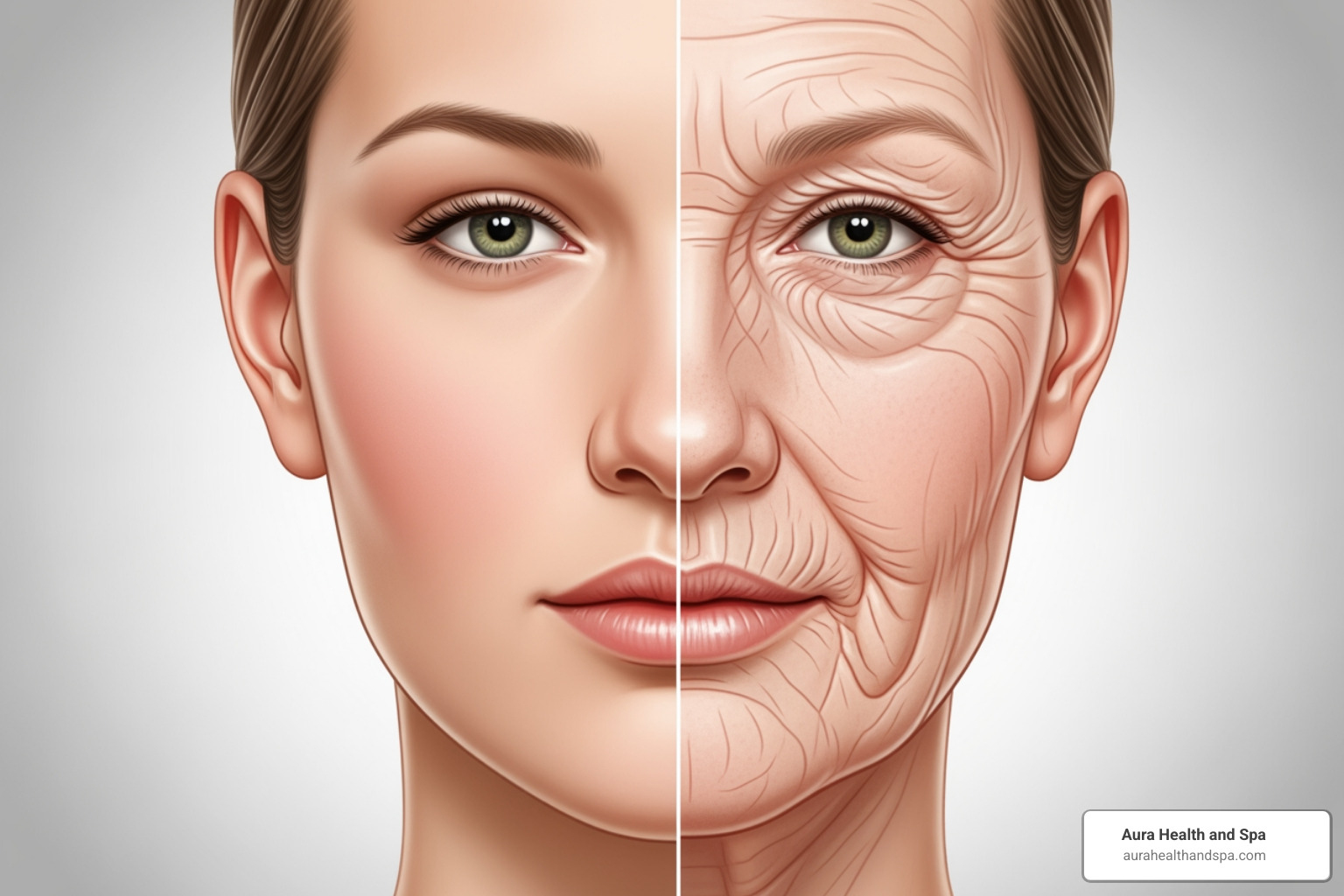
Understanding these changes—from collagen degradation to fat pad migration to elastin loss—helps you see why modern facial rejuvenation treatment options work at multiple levels of your skin. If you want to dive deeper into the anatomical science behind facial aging, this scientific research on the anatomy of the aging face offers fascinating insights into the structural changes that occur over time.
Non-Surgical Facial Rejuvenation Treatment Options at Aura Health & Spa
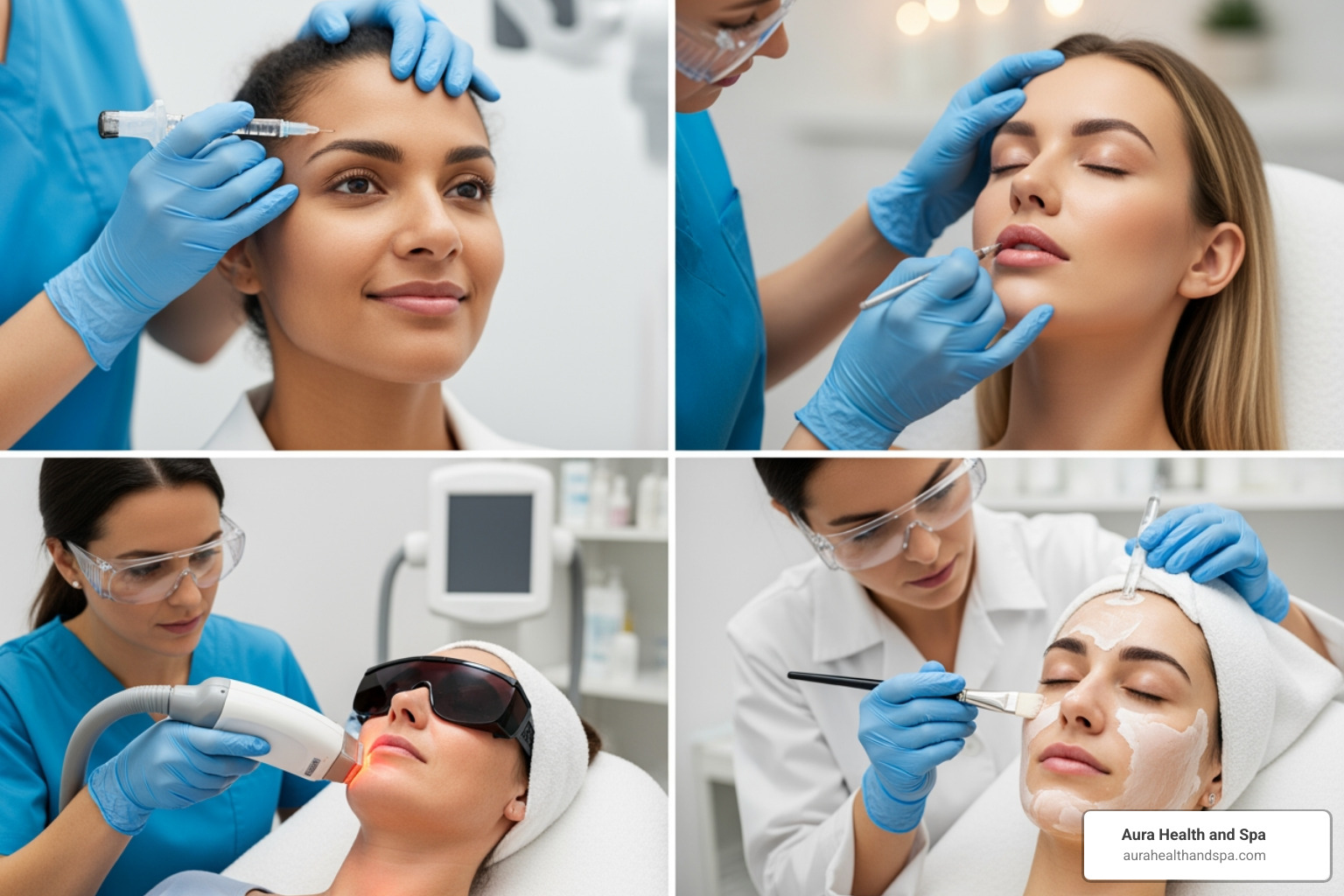
At Aura Health & Spa, we specialize in advanced, non-surgical facial rejuvenation treatment options that deliver real, visible results. Our approach is both preventative and corrective, using personalized treatment plans and trusted medical technologies to help you look refreshed, not overdone. These treatments offer minimal downtime, allowing you to look younger and feel more confident without putting your life on hold.
Injectables: Restoring Volume and Smoothing Wrinkles
Injectables are among the most popular and effective cosmetic procedures performed today.
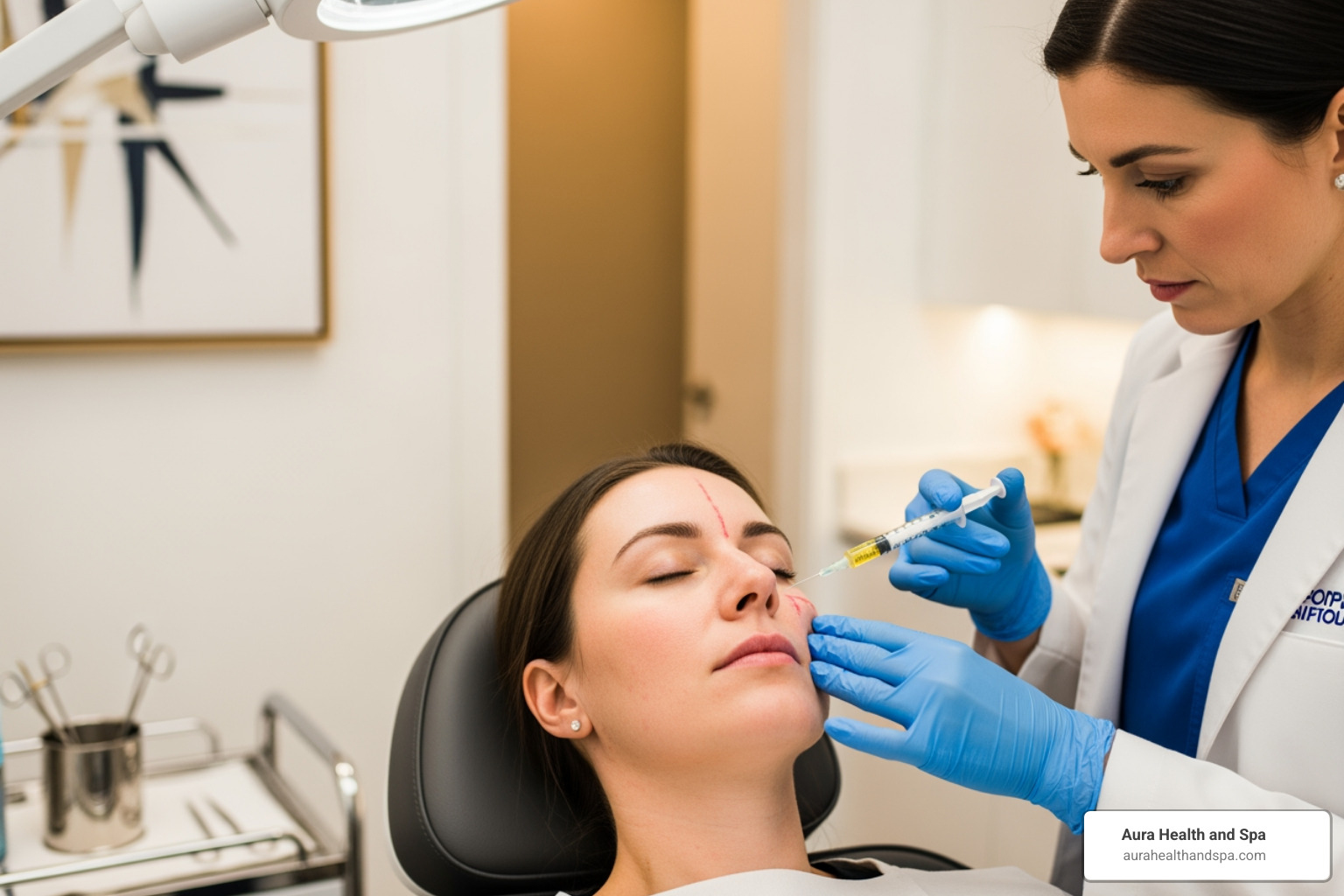
Neuromodulators like Botox temporarily relax the muscles that cause dynamic wrinkles, such as forehead lines, the “11s” between the brows, and crow’s feet. This smooths the overlying skin for a more relaxed, youthful look. Results typically last three to four months, and regular treatments can prevent lines from deepening. Choosing an experienced provider is crucial to minimize risks like temporary muscle weakness. Scientific research consistently supports the effectiveness of Botulinum Toxin for facial rejuvenation.
Dermal fillers, typically made with hyaluronic acid (HA), restore volume and smooth static wrinkles. Since HA is a natural substance in your skin, these fillers integrate seamlessly to add fullness to cheeks, lips, and under-eye hollows, while softening lines like nasolabial folds. HA fillers also improve skin quality and are reversible. Results can last from six to 24 months, depending on the treatment area. Risks include temporary swelling or bruising.
Skin Resurfacing and Collagen Induction: Improving Texture, Tone, and Pigmentation
These therapies target the skin’s surface and underlying structure to improve texture, tone, and pigmentation. Skin resurfacing removes damaged outer skin layers to reveal fresher skin and trigger a healing response, improving your complexion.
Chemical peels use acid solutions (like AHAs or BHAs) to exfoliate the skin. Light peels offer brightening with no downtime, while medium-depth peels target age spots, fine lines, and mild scarring.
Microdermabrasion is a gentle, mechanical exfoliation that removes the outermost layer of dead skin. It improves fine lines and uneven tone with no recovery time, making it safe for all skin types.
Microneedling is a popular treatment that uses fine needles to create controlled micro-injuries, triggering the skin’s natural healing process and boosting collagen and elastin production (neocollagenesis). This improves fine lines, scars, pore size, and overall skin texture. Mild redness is temporary, usually fading within 72 hours. The scientific research on microneedling confirms its effectiveness.
Intense Pulsed Light (IPL), or photofacial, uses broad-spectrum light to target pigmentation (brown spots) and redness (broken capillaries). It is highly effective for treating sun damage, age spots, and rosacea, while also stimulating collagen for improved skin tone.
Radiofrequency (RF) skin tightening uses energy to heat deep skin layers, stimulating new collagen formation. This results in tighter, firmer skin on the face and neck. These non-invasive treatments are comfortable and require no downtime. Research continues to demonstrate the assessment of IPL and RF effects on skin rejuvenation.
Regenerative Aesthetics: PRP and Sculptra
Regenerative aesthetics work with your body’s own healing mechanisms to create natural, long-lasting rejuvenation from within.
PRP (Platelet-Rich Plasma) therapy uses the healing power of your own blood. We draw a small sample, concentrate the platelets to create a serum rich in growth factors, and reintroduce it into your skin. This stimulates cellular regeneration, gradually improving texture, firmness, and fine lines. PRP is excellent for delicate areas like under the eyes and activates your skin’s natural repair system for lasting results.
Sculptra is a unique biostimulatory injectable made from poly-L-lactic acid (PLLA). Instead of providing immediate volume like HA fillers, Sculptra stimulates your body’s own collagen production over a series of treatments. This results in a gradual and long-lasting restoration of volume and firmness, particularly in the cheeks, temples, and jawline. Results can last two years or more. Because it works gradually and is not immediately reversible, expert application is essential.
Ready to explore how these regenerative treatments can work for you? Start your rejuvenation journey with a personalized PRP Sculptra plan designed specifically for your goals.
Planning Your Facial Rejuvenation Journey
Starting your facial rejuvenation treatment journey is an exciting step. Thoughtful planning and expert guidance will help you feel confident and prepared.

Are You a Good Candidate for a Facial Rejuvenation Treatment?
An ideal candidate for facial rejuvenation treatment is in good general health, has realistic expectations, and is committed to maintaining results. The goal is to look like a refreshed version of yourself, not someone else. Non-smokers typically see better results, as smoking impairs healing and circulation. Your skin type and age also influence the best treatment plan. Many start with preventative care in their 20s and 30s, while others seek corrective treatments in their 40s, 50s, and beyond. A commitment to post-treatment care, including daily sunscreen, is crucial for long-lasting success.
Choosing a Qualified Provider and What to Expect
Choosing the right provider is the most critical step. Look for licensed, experienced professionals with proven expertise. At Aura Health & Spa, our team is led by Dr. Reema Sethi, a board-certified physician with over 15 years of clinical experience and specialized training in medical aesthetics.
Your journey starts with a thorough consultation at one of our Metro Detroit locations in Plymouth, Sterling Heights, or Ann Arbor. We conduct a detailed skin analysis, listen to your goals, and create a realistic treatment plan. We believe in transparency and education, not upselling.
The cost of treatment varies based on the procedure, number of sessions, and your goals. For example, peels and microneedling can range from $80 to $500+ per session, while injectables are priced by the unit or syringe. We provide clear, honest pricing during your consultation so you can make an informed decision that fits your budget.
Ready to take the next step? Find a qualified provider at Aura Health & Spa and schedule your personalized consultation at one of our convenient Metro Detroit locations.
Maintaining Your Results and Future Trends for Facial Rejuvenation Treatment
Maintaining your results is key. Post-treatment care is crucial and always includes daily use of sunscreen (SPF 30+) and a quality, medical-grade skincare routine. The longevity of results varies: Botox lasts 3-4 months, HA fillers 6-18 months, and biostimulators like Sculptra can last two years or more.
We recommend maintenance sessions to keep your results looking fresh. At Aura Health & Spa, our treatment packages and “Glow Club” membership make ongoing care affordable. We stay current with emerging trends, such as combination therapies (using multiple treatments for comprehensive results) and regenerative aesthetics (like PRP and Sculptra), ensuring we offer the most effective, modern solutions.
Frequently Asked Questions about Facial Rejuvenation
What is the most effective facial rejuvenation treatment?
There is no single “best” facial rejuvenation treatment. The most effective approach is personalized to your unique skin and goals. For example, Botox is ideal for dynamic wrinkles, while dermal fillers restore volume. Skin resurfacing treatments like chemical peels or microneedling address texture and tone.
At Aura Health & Spa, we often recommend combination therapy, using multiple treatments to achieve comprehensive, natural-looking results. A detailed consultation is essential to create a customized plan that targets your specific concerns.
How much do facial rejuvenation treatments cost?
The cost of facial rejuvenation treatment varies widely based on the procedure, number of sessions, and treatment area. As a general guide:
- Microdermabrasion and light peels: $80 – $200 per session.
- IPL photofacials and microneedling: $200 – $500+ per session.
- Injectables: Botox is priced per unit (e.g., $10-$15), and fillers are priced per syringe (e.g., $600-$800+).
- Regenerative treatments (PRP, Sculptra): These are a higher initial investment for long-term results.
We provide a clear, transparent price quote during your personalized consultation at Aura Health & Spa. We also offer packages and a “Glow Club” membership to make ongoing care more affordable.
What is the best age to start facial rejuvenation?
There is no single “best” age to start facial rejuvenation treatment. The right time depends on your personal goals and what you see in the mirror.
- Preventative Treatments: Many clients in their late 20s and early 30s use treatments like preventative Botox and light peels to slow the aging process and maintain their skin.
- Corrective Treatments: Clients in their 40s, 50s, and beyond often seek corrective treatments like dermal fillers, Sculptra, or skin tightening to address established wrinkles, volume loss, and sagging.
The decision is personal. A consultation allows us to assess your skin and recommend a plan that’s right for you, right now.
Conclusion: Restore Your Confidence with a Personalized Plan
Taking the step toward facial rejuvenation treatment is about restoring confidence and helping your reflection match how vibrant you feel inside. It’s not about chasing an unrealistic ideal, but about feeling good in your own skin.
Modern aesthetics offers a solution for nearly every concern, from fine lines and volume loss to uneven skin tone. Options range from injectables and skin resurfacing to regenerative treatments like PRP and Sculptra, which stimulate your body’s natural collagen production.
At Aura Health & Spa, we reject a one-size-fits-all approach. Your facial rejuvenation treatment plan will be completely customized to your unique goals. Led by Dr. Reema Sethi, our team combines 15 years of clinical expertise with an artistic eye to deliver safe, natural-looking results. We provide honest guidance and use trusted technologies to help you achieve a look you love.
Ready to take the first step? We’re here to guide you, whether you’re interested in prevention, correction, or the transformative power of regenerative aesthetics. Start your rejuvenation journey with a personalized PRP Sculptra plan at Aura Health & Spa today, and find what’s possible when science, artistry, and trust come together.