
Understanding Your Hair Transplant Recovery Journey
Hair transplant recovery is a journey that unfolds over 12 months, with different milestones at each stage. While Aura Health & Spa does not perform surgical hair transplants, we specialize in advanced, non-surgical treatments that can complement your recovery and improve your final results. Understanding the full timeline is key to managing expectations.
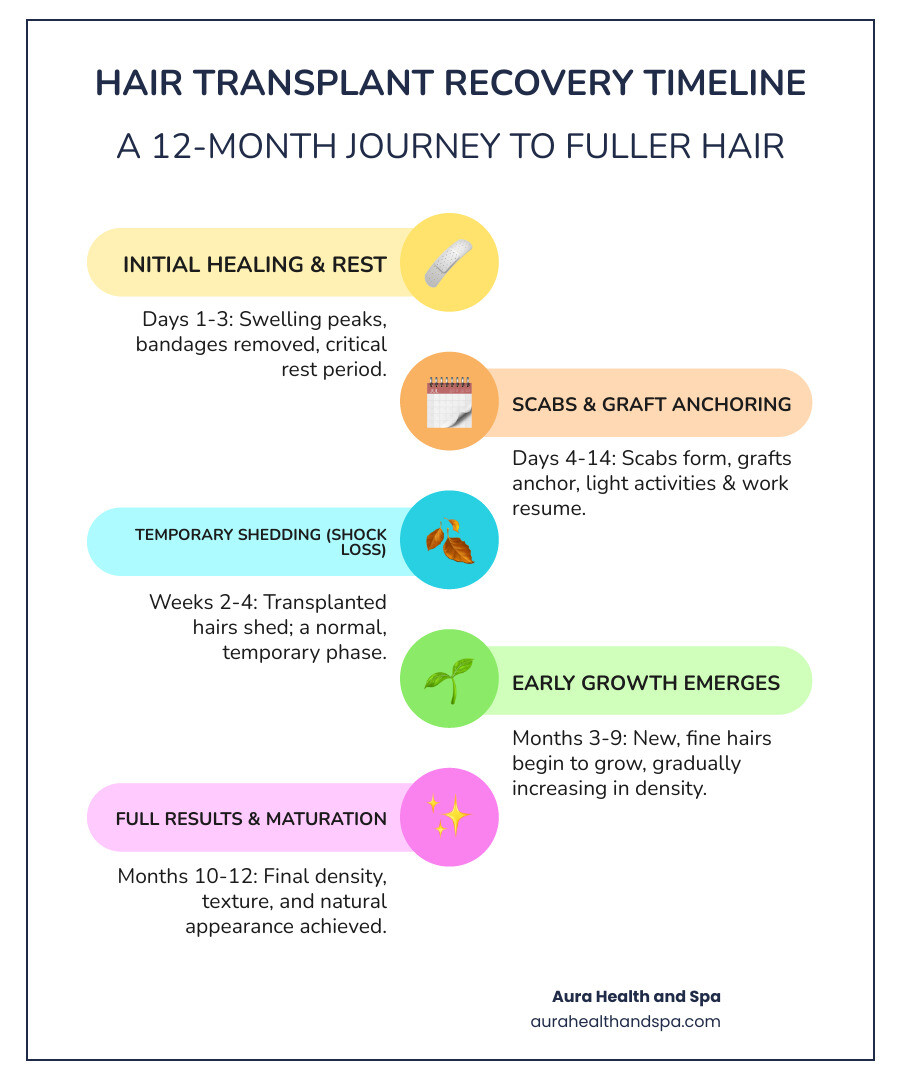
Quick Recovery Timeline:
- Days 1-3: Swelling peaks, bandages removed, rest required
- Days 4-10: Scabs form and begin to fall off naturally
- Days 7-14: Most patients return to work and light activities
- Weeks 2-4: Transplanted hairs shed (this is normal, not a failure)
- Months 3-4: New hair growth begins, fine and sparse at first
- Months 6-9: Roughly 60-70% of transplanted hair becomes visible
- Months 10-12: Full results appear, hair looks natural and undetectable
The recovery process requires patience. While the initial healing happens in just two weeks, seeing your final results takes nearly a year. During that time, you’ll experience stages that might feel discouraging—like when your newly transplanted hair falls out around week three. But this shedding is completely normal and temporary. The follicles stay in place and will produce new, permanent hair growth.
At Aura Health & Spa in Plymouth, Michigan, our team of licensed providers, under the direction of Dr. Reema Sethi, understands the importance of clear expectations during any recovery process. We help clients understand what to expect after a hair transplant and how our non-surgical treatments can support their healing and optimize growth at every stage.
Hair transplant recovery terms to remember:
The First Two Weeks: The Critical Healing Phase
The initial 14 days following a hair transplant are crucial for graft survival and setting the stage for successful growth. During this period, your scalp is sensitive, and the newly transplanted follicles are fragile as they work to establish a new blood supply. Most patients can return to work and light activities within 7-10 days after the procedure, though some may feel ready as early as 2-3 days post-procedure, depending on their comfort level and the nature of their work.
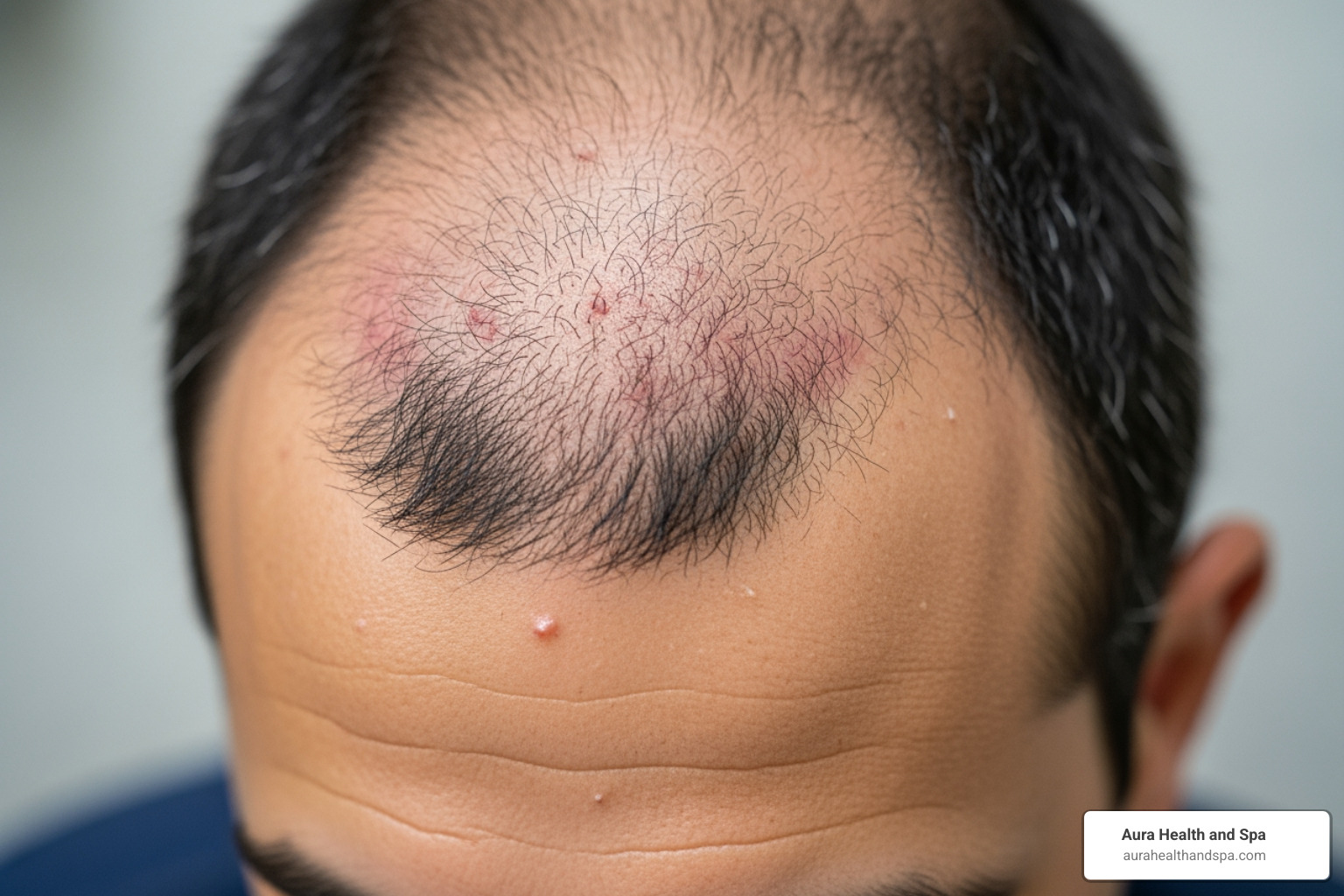
Immediately after the procedure, the transplanted area may appear slightly red, shiny, and swollen. You might have a small bandage around your forehead, and your surgeon may provide dressings for your scalp, typically worn for at least two days. Aching, tightness, or throbbing are common symptoms, usually manageable with prescribed pain medication. It’s also normal to experience some minor swelling, bruising, and drainage. Your surgeon will discuss these potential side effects with you, ensuring you know what to expect.
A critical aspect of early recovery is proper care to ensure the newly implanted follicles “anchor” or take hold. It typically takes around five days for the hair follicles to attach to blood vessels beneath the skin. Until then, they are vulnerable to dislodgement. Gentle washing and careful handling are paramount. Most clinics recommend washing the new transplants as early as the next day, using a cup to gently pour water and shampoo over the area, avoiding direct water pressure from a shower head or excessive rubbing. Letting the area air dry is often advised. For more detailed guidance, the Hair Transplantation – Aftercare & Recovery guidance provides helpful information.
Sleeping propped up at a roughly 45-degree angle with neck support (like a rolled towel or travel pillow) for the first few nights is highly recommended. This helps prevent swelling from moving to your face and keeps your head stable, protecting the delicate grafts. Avoiding long periods of looking downward, such as excessive cellphone use, can also help reduce swelling.
Your Day-by-Day Guide: Days 1-14
Understanding the day-by-day progression can help manage expectations during this critical phase:
- Days 1-3: Rest and swelling peak. The immediate post-operative experience involves a sensitive scalp, potential pain (especially in the donor area on the first night), and swelling that typically begins around day 2-3 and peaks on day 3 or 4. Rest is crucial, and most patients are given pain and antibiotic medications, which may only be needed for the first night. Keep your head liftd and avoid disturbing the grafts.
- Days 4-7: Scabs form, grafts anchor. Around day 4, the newly implanted follicles begin to anchor and become more permanent. Scabs will form on both the donor and recipient sites. It’s vital not to pick or scratch these scabs to avoid infection or scarring. Gentle washing can begin, often involving diluted shampoo and low-pressure water.
- Days 7-10: Scabs begin to fall, redness subsides. Scabs usually start falling off around day 5 and are mostly gone by day 10. You should allow them to shed naturally. If scabs persist after 10 days, a gentle rub might be advised by your surgeon, as the grafts are typically fully anchored by this point. Redness also begins to fade, though it can linger longer for some skin types. Most patients can return to work or school by day 10.
- Days 10-14: Most scabs gone, return to light activities. By the end of the second week, most immediate signs of the procedure, like prominent scabbing, should be gone. The scalp may still have some pinkness. Most restrictions on activities are lifted, and you can resume light exercise. However, strenuous activity, swimming, and excessive sun exposure should still be avoided.
The “Ugly Duckling” Stage: Shedding and Waiting (Week 3 to Month 4)
After the initial healing phase, many patients enter what is affectionately known as the “ugly duckling” stage. This phase, occurring roughly from week 3 to month 4 post-surgery, can be emotionally challenging but is a completely normal and temporary part of the hair transplant recovery process.
The most notable event during this period is shock loss, where the newly transplanted hair shafts fall out. This often happens between 2-4 weeks after surgery, or even up to six weeks. This shedding is not a sign of failure; it means the hair follicles have entered a dormant, or telogen, resting phase. The follicles themselves remain healthy and securely in place, preparing to grow new hair. About 70-80% of transplanted hair may shed between 1-3 months post-surgery.
During this dormant phase, your scalp may appear similar to how it looked before the transplant, which can be discouraging. Patience is truly key here. The follicles are resting and regenerating, ready to produce new hair growth.
Another concern during this stage can be folliculitis, an inflammation of the hair follicles that can manifest as small, pimple-like bumps. This can occur as new hairs prepare to emerge. If you experience folliculitis, your surgeon may recommend applying antibiotic ointments or an antibiotic spray for a few days to minimize infection risk and support healing. Maintaining good scalp hygiene is crucial during this time.

The Road to Results: Your Hair Transplant Recovery Timeline (Month 4 to 12+)
After the shedding phase and the period of dormancy, the exciting part begins: new hair growth. This journey unfolds gradually, requiring continued patience and care.
- Early hair growth: New hair growth typically begins between 3 to 5 months after surgery. These initial hairs are often fine and thin, sometimes described as “baby” hairs. They may even appear a different texture or be curlier than your natural hair at first. This is a positive sign that the follicles are active. New hairs emerge around the fourth month and grow at a slow and steady rate of approximately 1 cm (half an inch) per month.
- Increased density over time: As the months progress, these fine hairs will start to thicken, and more new hairs will emerge. By the 6-month mark, increased density and comb-able hair become noticeable. Around 60-70% of the transplanted hair is typically visible by months 5-8.
- Hair maturation: The hair will continue to mature, gaining thickness, length, and a more natural texture. By the 10-month mark, the vast majority of hair transplant post-op patients will have achieved full, natural, healthy hair growth.
- Styling new hair: Once the hair has grown sufficiently, you can start styling it as desired. It’s advisable to inform your stylist about the transplant for your first haircut.
- Full results timeline: Full results of a hair transplant are typically visible around the 12-month mark. Some individuals may even experience continued thickening and improvement up to 18 months post-procedure.
What to Expect During Your Hair Transplant Recovery
The journey to full hair growth is a gradual one, with distinct milestones:
- Months 4-6: Visible but sparse progress. During this period, you’ll start to see new hair growth, but it might still appear patchy or sparse. The new hairs are often thin. This is a normal stage, and the density will continue to improve. Roughly 40-60% of the final result is typically visible by month six.
- Months 6-9: Noticeable thickening and coverage. This is when significant changes become apparent. The new hairs thicken, and the overall density and coverage improve dramatically. You’ll likely feel much more confident with your appearance during this stage.
- Months 9-12+: Final density and texture achieved. By the 9-12 month mark, you should see the full results of your transplant. The hair will have matured, blending seamlessly with your existing hair, and allowing for normal styling. A follow-up appointment with your surgeon is recommended around this time to assess the final outcome. In rare cases, if you have concerns about the results, it’s important to know What to do if you have problems with cosmetic surgery.
Optimizing Your Hair Transplant Recovery and Long-Term Health
While the hair transplant procedure itself is a significant step, optimizing your recovery and maintaining long-term hair health is equally important. Following your surgeon’s specific aftercare instructions is paramount. This includes:
- Scalp hygiene: Continue gentle scalp care, using recommended shampoos and avoiding harsh products. Keeping the scalp clean helps prevent issues like folliculitis.
- Sun protection: Protect your scalp from direct sun exposure, especially in the first few months. A loose-fitting hat or sunscreen (once cleared by your surgeon) can prevent damage to the delicate new grafts.
- Healthy diet: A balanced diet rich in vitamins and proteins supports overall healing and hair growth.
- Avoiding stress: Stress can negatively impact hair health. Managing stress through relaxation techniques or other methods is beneficial.
- Following surgeon’s advice: Adhere to all advice from your surgeon regarding activities, medications, and any specific care instructions.
- Follow-up appointments: Regular check-ups with your hair restoration specialist allow them to monitor your progress, address any concerns, and provide ongoing guidance.
For those in Plymouth, Michigan, looking to support their hair health or improve density, especially after a hair transplant, our non-surgical services at Aura Health & Spa can be a valuable complement to your journey.
Enhancing Hair Density and Health Without More Surgery
At Aura Health & Spa in Plymouth, Michigan, we specialize in advanced, non-surgical aesthetic treatments to help you look and feel your best. While we do not perform hair transplant surgeries, we offer powerful, non-invasive solutions designed to improve hair density, stimulate growth, and maintain scalp health. These treatments are ideal for those seeking alternatives to surgery or looking to complement their hair transplant recovery with additional support. Our focus is on visible improvement without extensive downtime, aligning with our core idea that “Confidence starts with results you can see.”
Our advanced treatments leverage cutting-edge technology and regenerative medicine to target hair thinning and promote a healthier, fuller head of hair. We believe in a comprehensive approach, often pairing treatments with professional skincare to improve results and value. More info about our advanced spa services can be found on our website.
Advanced Laser Treatments for Hair Restoration
For individuals experiencing hair thinning, our FolixMD treatment offers a powerful solution. We use the Lumenis FoLix fractional laser, a state-of-the-art device designed for effective hair restoration.
- Follicle stimulation: The FolixMD treatment works by creating microthermal zones with targeted, concentrated energy in the scalp. This precise energy delivery activates the body’s natural healing response, stimulating dormant hair follicles and encouraging new hair growth.
- Targeted energy vs. LLLT: It’s important to clarify that the Lumenis FoLix laser used in our FolixMD treatment is NOT a low-level laser therapy (LLLT) device. While LLLT uses low-power lasers, our fractional laser delivers a more powerful and direct approach, creating controlled micro-injuries that significantly boost cellular activity and circulation in the scalp. This targeted energy helps to refresh the scalp environment, making it more conducive to hair growth.
This treatment is an excellent option for those in Plymouth, MI, looking for a non-surgical way to improve hair density and vitality. Discover our Hair Restoration with FolixMD to learn more.
Regenerative Medicine for Thicker, Healthier Hair
Beyond laser therapy, we harness the power of regenerative medicine to nourish the scalp and improve hair thickness. Our primary treatments, De|Rive Ultra Plus and PRP, use your body’s own healing capabilities to achieve natural-looking results.
- Topical Plant-Based Serums: We offer De|Rive Ultra Plus, a 100% natural, plant-based topical serum. This innovative treatment is applied in-office and includes a take-home supply to continuously nourish and hydrate the scalp, reduce inflammation, and improve follicle health for thicker, fuller-looking hair.
- Growth factors: We offer PRP (Platelet-Rich Plasma) therapy, which involves drawing a small amount of your blood, processing it to concentrate the platelets (rich in growth factors), and then injecting this plasma into your scalp. These growth factors stimulate hair follicles, prolong the hair growth phase, and improve hair density and thickness.
- Nourishing the scalp: Our Regenerative SkinPen Microneedling with PDGF+ (Platelet-Derived Growth Factor) is another exceptional treatment. Microneedling creates tiny channels in the scalp, enhancing the absorption of topical treatments. When combined with PDGF+, a potent growth factor, it provides a powerful boost to scalp health and hair follicle function. This treatment helps to improve blood flow, deliver essential nutrients, and encourage the growth of thicker, healthier hair.
These regenerative treatments are ideal for those seeking to combat thinning hair, improve hair quality, or provide additional support to the scalp after a hair transplant procedure performed elsewhere, all without the need for further surgery.
Frequently Asked Questions About Hair Transplant Recovery
Navigating the hair transplant recovery journey often brings up many questions. Here, we address some of the most common concerns patients have.
How long until I can return to normal activities like work and exercise?
The timeline for returning to normal activities varies, but most patients find they can resume light routines relatively quickly:
- Return to work timeline: Many individuals feel well enough to return to work and light activities within 7-10 days after the procedure. Some sources even suggest returning to work within 2-3 days post-procedure, especially for desk jobs, though visible redness or scabs might still be present. If discretion is important, planning for at least a week of downtime or wearing a loose, breathable hat (once cleared by your surgeon) is advisable.
- Light activity vs. strenuous exercise: While light activities can resume relatively early, strenuous activity may need to be avoided for at least three weeks. This includes heavy lifting, gym work, running, cycling, and contact sports. The goal is to prevent excessive sweating, pressure on the scalp, or activities that could dislodge grafts or reopen incisions.
- Resuming sports: Most clinics allow patients to resume normal exercise activity around the 10-day mark, when grafts are fully anchored, but contact sports or activities that risk head trauma should be avoided for longer, often three weeks.
- Sexual activity guidelines: Some doctors advise that sexual activity be avoided for at least 10 days after surgery to prevent increased blood pressure to the scalp and potential graft dislodgement.
Is the shedding of transplanted hair permanent?
No, the shedding of transplanted hair is not permanent; it is a normal and temporary part of the recovery process, often referred to as “shock loss.”
- Shock loss explained: Within six weeks after surgery, or typically between 2-4 weeks, the newly transplanted hair shafts will fall out. This occurs because the follicles enter a dormant phase due to the trauma of transplantation.
- Temporary phase: While the hair shafts shed, the hair follicles themselves remain intact and healthy beneath the scalp. This shedding does not mean the transplant has failed.
- Hair growth cycle: After the dormant phase, the follicles will re-enter the anagen (growth) phase.
- When new growth begins: After the transplanted hair falls out, it will take another five to six weeks before hair growth resumes. New hair growth typically begins between 3 to 5 months after surgery. This new hair will be permanent and continue to grow naturally.
How should I care for my scalp in the months following surgery?
Proper scalp care is crucial for optimal healing and to support the long-term health of your transplanted hair.
- Gentle shampoos: Continue using gentle, pH-balanced shampoos recommended by your surgeon. Avoid harsh chemicals, strong detergents, or products with excessive fragrances that could irritate the healing scalp.
- Avoiding harsh chemicals: Refrain from using hair dyes, perms, or other chemical treatments for several months, or until cleared by your surgeon.
- Sunscreen for the scalp: Protect your scalp from direct sun exposure. After the initial healing period (usually a few weeks), use a broad-spectrum sunscreen, preferably an aerosol spray for thorough coverage, on your scalp when outdoors. Wearing a hat is also a good practice.
- Scalp massage: Once your surgeon approves, gentle scalp massages can help improve circulation and promote a healthy scalp environment.
- Long-term maintenance: Consider incorporating non-surgical treatments into your routine. For example, at Aura Health & Spa in Plymouth, Michigan, we offer advanced treatments like FolixMD laser therapy, De|Rive Ultra Plus topical serum, PRP, and Regenerative SkinPen Microneedling with PDGF+ that can help nourish your scalp, stimulate hair growth, and improve overall hair density and health, complementing the results of your transplant. Maintaining a healthy lifestyle, including a balanced diet and managing stress, also contributes significantly to long-term hair health.
Conclusion: Your Journey to a Fuller Head of Hair
The journey through hair transplant recovery is a marathon, not a sprint. It demands patience, meticulous care, and a clear understanding of each phase, from the initial healing and temporary shedding to the gradual emergence of new, natural hair. While the process can feel long, the reward of a fuller, healthier head of hair is often transformative, and our team can help support your results.
At Aura Health & Spa, we are dedicated to helping individuals in Plymouth, Michigan, achieve their aesthetic goals and boost their confidence. For those who have undergone a hair transplant, our non-surgical treatments offer a powerful way to support scalp health, nourish new follicles, and improve the density of your final results. Our expert team, led by Dr. Reema Sethi, is committed to delivering safe, effective, and customized aesthetic treatments using the most trusted medical technologies. We pride ourselves on offering options like our FolixMD laser treatment, De|Rive Ultra Plus serum, PRP therapy, and Regenerative SkinPen Microneedling with PDGF+—all designed to help you restore, improve, and maintain your best look.
We invite you to explore our advanced hair restoration services today and find how we can support your journey to a fuller, more confident you.