
Why Migraine Injections Are Changing Lives
Migraine injection treatments offer hope for millions who struggle with debilitating headaches that resist traditional oral medications. If you’re one of the approximately one in six Americans affected by migraine, you know how these episodes can derail your work, relationships, and daily life.
Quick Answer: Your Migraine Injection Options
| Injection Type | Purpose | Frequency | How It Works |
|---|---|---|---|
| CGRP Inhibitors | Prevention | Monthly or quarterly | Block migraine-triggering proteins |
| Botulinum Toxin (Botox) | Prevention | Every 3 months | Block pain signals at nerve endings |
| Triptans/DHE | Acute relief | As needed | Stop active migraine attacks |
| Nerve Blocks | Targeted relief | Variable | Numb specific pain pathways |
The reality: oral medications don’t work for everyone. Pills can cause side effects, require daily dosing you might forget, or simply fail to prevent your next attack. That’s where injectable treatments step in.
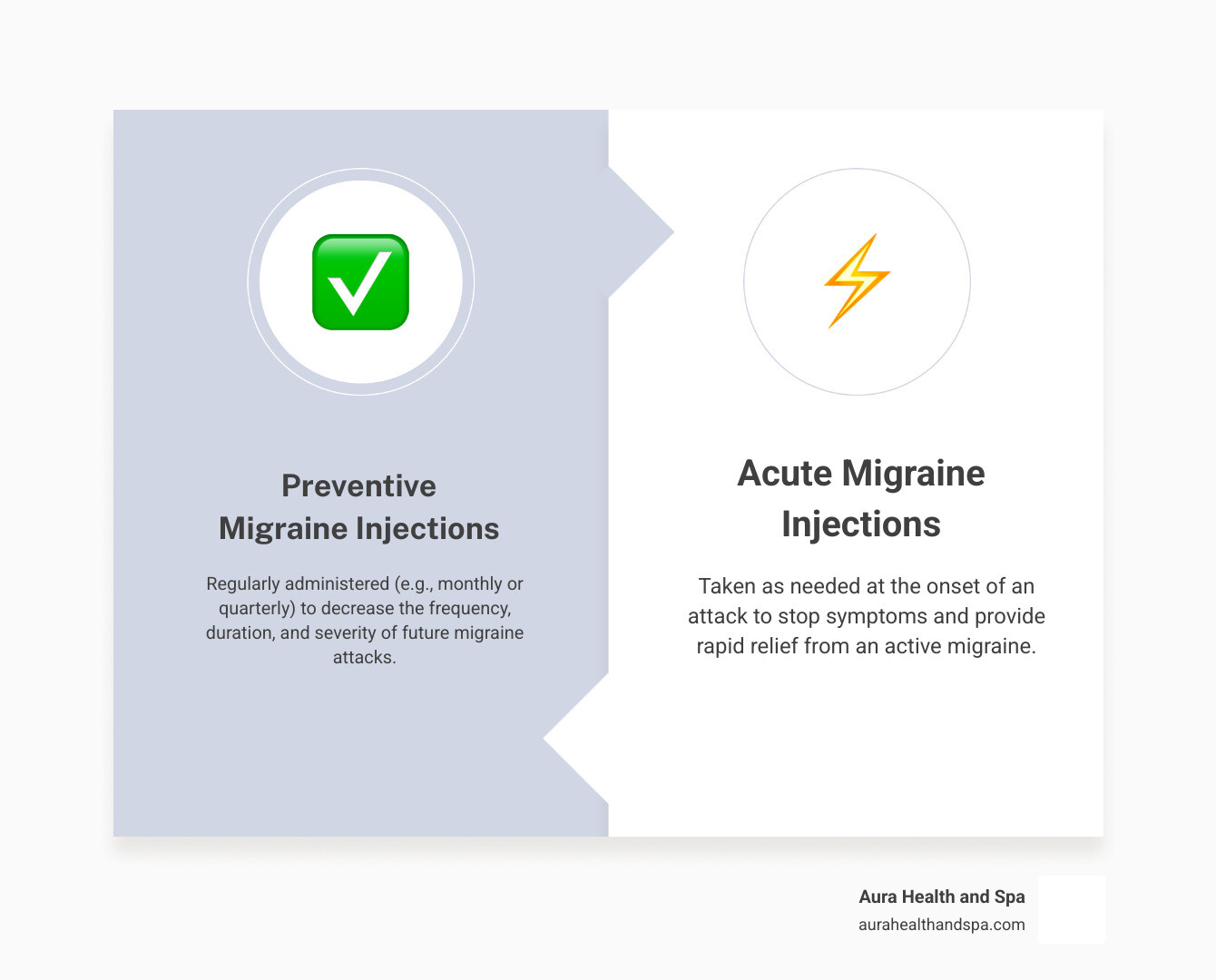
Injectable migraine treatments fall into two main categories:
- Preventive injections reduce how often migraines occur
- Acute injections stop a migraine that’s already started
The good news? Today’s injectable options are more sophisticated than ever. Some you can administer yourself at home. Others require a brief office visit. Many patients experience a 50% or greater reduction in monthly migraine days—a change that brings back the life they thought they’d lost.
As Dr. Reema Sethi, a board-certified emergency medicine physician with over 15 years of experience, I’ve witnessed how debilitating migraines can be—and how effective the right migraine injection treatment can be for patients who’ve exhausted other options. Now, at Aura Health & Spa in Metro Detroit, I help patients in locations like Plymouth, Sterling Heights, and Ann Arbor explore these advanced treatment options in a comfortable, professional setting.
This guide will walk you through each type of migraine injection, how they work, what to expect, and how to determine which option might be right for you.
Understanding the Main Types of Migraine Injections
When you’re dealing with migraine, understanding your treatment options can feel overwhelming. But here’s the good news: injectable treatments have come a long way, and they’re helping people reclaim their lives in ways oral medications often can’t.
At Aura Health & Spa, we believe knowledge is power. So let’s break down the main categories of migraine injection treatments you might encounter: preventive therapies that stop migraines before they start, acute therapies that halt an attack in progress, and procedural injections that target specific pain areas.
Preventive Injections: CGRP Inhibitors
Imagine being able to stop a migraine before it even begins. That’s exactly what CGRP inhibitors do—and they’re revolutionizing migraine prevention.
These medications are monoclonal antibodies that target a specific protein called calcitonin gene-related peptide, or CGRP for short. This protein plays a major role in triggering migraine attacks, and by blocking it, these injections can dramatically reduce how often migraines occur.
Four main CGRP inhibitors are available today: erenumab (Aimovig), fremanezumab (Ajovy), galcanezumab (Emgality), and eptinezumab (Vyepti). While each has subtle differences, they’re all remarkably effective at preventing migraine.
The real game-changer? Most of these are designed for self-injection at home. Depending on which medication you choose, you might inject monthly or as infrequently as once every three months. That convenience means you’re not constantly running to the doctor’s office.
Take Emgality, for example. Studies show it can reduce overall headache days by 63% and severe headache days by 50%. Some people notice improvements within the first week. That’s the kind of life-changing relief that makes these preventive migraine injection treatments worth considering.
Preventive Injections: Botulinum Toxin
Yes, we’re talking about Botox—but not just for wrinkles. Since 2010, onabotulinumtoxinA has been FDA-approved specifically for preventing chronic migraine in people who experience headaches 15 or more days per month.
How does it work? Botox blocks pain signals at the nerve endings in your head and neck. Scientific research on Botulinum toxin for chronic migraine suggests it may also prevent the release of CGRP from nerve cells, giving it a double mechanism for fighting migraine.
The treatment involves multiple small injections around your head, neck, and shoulders—about 31 injections total, administered every 12 weeks. It sounds like a lot, but the procedure is quick and relatively comfortable.
At Aura Health & Spa, our medically trained staff in Plymouth, Sterling Heights, and Ann Arbor have extensive experience with Botox treatments. While many people know us for aesthetic Botox, we’re equally skilled at the precise, therapeutic application that helps chronic migraine sufferers find lasting relief.
Acute (Abortive) Injections for Rapid Relief
Even with the best prevention, breakthrough migraines can still happen. That’s when acute migraine injection treatments become your rescue plan.
These medications aren’t about prevention—they’re designed to stop an active migraine attack as quickly as possible. Think of them as your emergency brake.
Triptans, particularly sumatriptan, are the most common acute injections. They work by narrowing blood vessels in the brain and blocking pain signals. You can self-inject sumatriptan at the first sign of a migraine, and it acts fast—often bringing relief within an hour. It’s also effective for cluster headaches.
Dihydroergotamine (DHE) is another powerful option. Like triptans, DHE constricts blood vessels to stop the throbbing pain and other migraine symptoms in their tracks.
These injections are used as needed—only when a migraine strikes. Just remember: using them too frequently (more than 10 days per month) can actually cause medication-overuse headaches. Your doctor will help you find the right balance.
Other Procedural Injections: Nerve Blocks & Trigger Points
Sometimes the most effective approach is targeting pain right at its source. That’s where procedural injections come in.
Occipital nerve blocks involve injecting a local anesthetic—sometimes combined with a steroid—around the occipital nerves at the back of your head. By temporarily blocking these pain pathways, nerve blocks can reduce both the severity and frequency of your migraine attacks. The frequency of these treatments varies based on your individual needs.
Trigger point injections address a different problem: muscle tension. A 2014 study on trigger point pain in migraine found that around 94% of people with migraine experience trigger point pain—those tender knots in your muscles that seem to radiate discomfort.
These injections target specific muscle knots in your head, neck, and shoulders. By injecting an anesthetic directly into these tight spots, we can relax the muscle and relieve the referred pain that contributes to your migraines.
Both nerve blocks and trigger point injections are administered by a medical professional in a clinical setting. They offer a focused, targeted approach for people whose migraine pain concentrates in specific areas.
How a Migraine Injection Works: The Science of Relief
Understanding the science behind these treatments isn’t just interesting—it helps you make informed decisions and feel confident about your care. When you know why a migraine injection works, the treatment becomes less mysterious and more empowering.

Targeting CGRP: The Breakthrough in Migraine Prevention
For decades, migraine was a puzzle with missing pieces. Then researchers finded something remarkable: a protein called calcitonin gene-related peptide, or CGRP for short. This molecule turned out to be a major player in migraine attacks.
During a migraine episode, your body releases liftd levels of CGRP. In fact, a 2013 study found that women with chronic migraine had blood CGRP levels more than twice as high as women without migraine. This protein doesn’t just sit there quietly—it actively promotes vasodilation, the widening of blood vessels in your brain. This widening increases pain signals and inflammation, setting off the cascade of symptoms you know all too well.
CGRP inhibitors work like a highly trained security team, intercepting the problem before it starts. Some of these medications bind directly to the CGRP molecule itself, preventing it from ever reaching its target. Others take a different approach, attaching to the CGRP receptor and blocking the protein from activating it. Either way, the result is the same: the CGRP pathway gets interrupted, and your migraine frequency drops.
The beauty of this targeted approach is precision. Unlike older preventive medications that affected multiple systems in your body, CGRP inhibitors zero in on one specific pathway. This means fewer side effects and better tolerability for most people. If you’re curious about the detailed science behind this breakthrough, you can explore more about the CGRP pathway in migraine.
How Botulinum Toxin Prevents Migraine Pain
You might wonder how the same substance that smooths wrinkles can prevent migraine pain. The answer lies in what Botox does beneath the surface—and it goes far beyond muscle relaxation.
When we administer Botox for chronic migraine, we inject it into specific muscles around your head and neck. At these injection sites, the botulinum toxin blocks the release of neurotransmitters—the chemical messengers that nerves use to communicate. By preventing these signals from being sent, Botox essentially quiets down overactive nerves that would otherwise transmit pain signals to your brain.
But there’s more to the story. Recent research suggests that Botox may also reduce the release of CGRP itself from nerve cells. This means it’s working on multiple levels: stopping pain signals from traveling and reducing the inflammatory proteins that trigger migraine in the first place. It’s a mechanism that goes well beyond simple muscle relaxation, which is why Botox has become such a valuable tool for people with chronic migraine.
At Aura Health & Spa, our medical team has extensive experience with precise Botox administration. We understand exactly where to place each injection to maximize your relief while maintaining natural facial movement and expression.
The Mechanism of an Acute Migraine Injection
When a migraine has already started, you need a different strategy. Acute migraine injection treatments like sumatriptan and DHE work quickly because they target the active migraine process happening right now in your brain.
These medications are serotonin receptor agonists, which means they activate specific serotonin receptors in your brain. When these receptors are activated, they trigger vasoconstriction—the narrowing of blood vessels. Since vasodilation (widening) is a key component of migraine pain, reversing this process helps stop the attack in its tracks.
But that’s not all these medications do. They also block the release of pain-causing substances and reduce nerve activity throughout the pain pathways. It’s like hitting the emergency brake on a migraine that’s already in motion. The result is rapid relief when you need it most, often within minutes to an hour after injection.
This is why timing matters with acute treatments. The sooner you can administer them after your migraine symptoms begin, the more effectively they can halt the pain cascade before it fully develops.
Administration, Dosing, and What to Expect
Once you and your doctor decide a migraine injection is right for you, the next step is understanding how it’s administered and what your treatment schedule will look like. The good news? Many of these treatments are surprisingly convenient, and our team at Aura Health & Spa is here to make sure you’re comfortable with every aspect of your care.

Self-Injection vs. In-Office Procedures
The way you receive your migraine injection depends entirely on which treatment you’re using. Some you can do yourself at home, while others require a visit to a medical professional.
Many CGRP inhibitors, like Aimovig, Ajovy, and Emgality, are designed for self-administration at home. These come in two main formats: autoinjector pens and prefilled syringes. Autoinjector pens are incredibly user-friendly—often just a push-down or push-button mechanism that’s designed to be done by the person themselves. Prefilled syringes require you to see the needle, which some people find intimidating, but they’re sometimes considered less painful. If you’re new to self-injection, don’t worry. We provide thorough training and support to ensure you feel confident managing your treatment independently.
One CGRP inhibitor, Eptinezumab (Vyepti), works differently. It’s given as an intravenous (IV) infusion in our comfortable Metro Detroit clinic. The infusion takes about 30 minutes, once every three months. The advantage? The medication gets into your system and starts working faster—clinical trials show that eptinezumab can reduce migraine frequency the day after the infusion.
For treatments like Botox for chronic migraine, nerve blocks, and trigger point injections, you’ll need a trained medical professional to administer them. Botox involves a series of 31 to 39 small injections into specific areas of your head and neck. These precise placements are crucial for effectiveness, which is why they’re performed by our expertly trained staff at Aura Health & Spa in Plymouth, Sterling Heights, and Ann Arbor. We ensure both your comfort and the best possible results.
Typical Dosing Schedules for Preventive Injections
Consistency matters when it comes to preventive treatments. Your body needs time to respond, and sticking to your recommended schedule gives you the best chance at meaningful relief.
CGRP inhibitors offer flexible dosing based on the specific medication and your individual needs. You might need a CGRP injection once a month or once every four months, or sometimes less frequently. For example, Emgality is typically given monthly, while Vyepti is administered quarterly. This flexibility means you can find a schedule that fits your lifestyle.
Botulinum toxin (Botox) injections for chronic migraine are usually given every 10 to 12 weeks—roughly every three months. Here’s something important to know: it may take multiple rounds of injections over the course of up to six months before you reach the maximum benefit of Botox. Patience pays off, though. With consistent treatment, many of our patients experience significant long-term relief that transforms their quality of life.
Nerve blocks have more variable schedules. Some patients find relief for several weeks after a single treatment, while others benefit from more frequent injections. This is something we’ll work out together based on how your body responds. At Aura Health & Spa, we believe in personalizing your treatment plan to match your unique needs and response to therapy.
Frequently Asked Questions about Migraine Injections
We know you have questions, and we’re here to provide clear, straightforward answers. These are the questions we hear most often at Aura Health & Spa, and we want you to feel fully informed as you consider your options.
How effective is a migraine injection?
This is the question that matters most, isn’t it? After all, you’re looking for real relief, not just another treatment that might help.
The good news is that migraine injection treatments have proven remarkably effective for many people. When it comes to CGRP inhibitors, research shows that many patients experience a 50% or greater reduction in monthly migraine days. Think about what that could mean for you—cutting your migraine days in half. Studies on specific medications have shown even more encouraging results: erenumab can lower severe headache days by 50%, while fremanezumab reduces overall headache days by 63%.
Botox for chronic migraine has shown similarly impressive results, particularly for people who experience at least 15 migraine days a month. It’s been a game-changer for those with chronic migraine who haven’t found adequate relief elsewhere.
The effectiveness of these preventive treatments builds over time with consistent use. You’re not just treating one migraine—you’re changing your baseline, giving yourself more migraine-free days to live your life.
Acute injections like sumatriptan and DHE work differently. They’re not about prevention; they’re about stopping a migraine that’s already started. While they won’t reduce your future migraine frequency, they can provide powerful, fast-acting relief when you need it most, often within 30 to 60 minutes.
How much do migraine injections cost?
Let’s talk honestly about cost, because it’s a real consideration for everyone.
CGRP inhibitors typically cost around $7,000 per year without insurance coverage. That’s a significant investment, and we understand that’s not feasible for everyone without help.
Botox treatments for chronic migraine tend to be more budget-friendly, ranging from $300 to $600 per treatment session. Since Botox is administered every three months, your annual cost could be considerably less than CGRP inhibitors if you’re paying out of pocket.
Here’s the reality: insurance coverage varies dramatically. Some plans cover these treatments generously after you’ve tried other options. Others require extensive prior authorization or may not cover them at all. We always recommend calling your insurance provider before starting treatment to understand your specific benefits, deductibles, and any requirements they have.
At Aura Health & Spa, we believe in complete transparency about pricing. During your consultation, we’ll give you clear information about costs upfront—no surprises, no hidden fees, no unnecessary add-ons. We want you to make an informed decision that fits both your health needs and your budget. Many pharmaceutical companies also offer patient assistance programs that can significantly reduce your out-of-pocket costs, and we’re happy to help you explore those options.
How do I know if a migraine injection is right for me?
This is perhaps the most important question, and the answer starts with a conversation. Migraine injections aren’t appropriate for everyone, which is why a thorough consultation with a medical professional is essential.
At Aura Health & Spa, we take time to understand your unique situation. We’ll start by discussing your migraine history in detail—how often they occur, how severe they are, what your triggers might be, and how these attacks affect your daily life. We’ll review any oral medications or other treatments you’ve already tried. Many of our clients come to us after traditional oral medications haven’t provided the relief they need, and that’s often when injectable treatments become worth considering.
Your complete medical history matters too. Certain migraine injection treatments may not be recommended if you have specific health conditions. For instance, there are still unanswered safety questions about CGRP injectables for people with recent vascular disease or poorly controlled cardiovascular disease. These treatments are also generally not approved for children, so age is a factor we’ll consider.
We’ll talk about your lifestyle and preferences as well. Are you comfortable with self-injections at home, or would you prefer coming to our clinic for in-office treatments? Are you looking primarily for prevention, or do you need acute relief options for when a migraine strikes? Your goals and comfort level guide our recommendations.
If you’re pregnant, planning to become pregnant, or currently breastfeeding, we’ll have an honest discussion about timing. CGRP injectables, for example, stay in your system for a long time, so doctors typically ask people to stop these treatments about five to six months before trying to conceive.
Our guiding principle at Aura Health & Spa is “Results First.” We’re not here to push any particular treatment—we’re here to help you find what actually works. Our medically trained staff prioritizes education and personalized care, ensuring your treatment plan is safe, effective, and custom specifically to your needs. We want to help you achieve measurable improvement in your migraine frequency and severity, so you can love your reflection again—not just in the mirror, but in how you feel every day, living with fewer migraines. Find out if Botox for migraine is right for you by scheduling a consultation with our team in Plymouth, Sterling Heights, or Ann Arbor.
Conclusion: Taking the Next Step Towards Fewer Migraine Days
Living with frequent migraines doesn’t have to be your reality. Throughout this guide, we’ve explored how migraine injection therapies are offering real hope to people who’ve struggled for years with debilitating headaches. From preventive treatments like CGRP inhibitors and Botulinum toxin that reduce how often migraines occur, to acute injections like triptans and DHE that stop attacks in their tracks, to targeted procedural options like nerve blocks and trigger point injections—you now have a comprehensive understanding of what’s available.
The science behind these treatments is remarkable. Whether it’s blocking the CGRP protein that triggers migraine attacks, preventing pain signals at nerve endings, or stopping the pain cascade of an active migraine, these therapies represent a genuine breakthrough for migraine sufferers. And perhaps most importantly, you’ve learned that finding the right treatment is a personalized journey that starts with an honest conversation about your symptoms, your medical history, and your goals.
At Aura Health & Spa, serving Plymouth, Sterling Heights, and Ann Arbor in Metro Detroit, we understand that confidence starts with results you can see—and feeling like yourself again, free from constant migraine pain, is one of the most powerful results we can help you achieve. Our team of medically trained professionals brings the same precision and expertise to therapeutic treatments like Botox for migraine that we apply to our aesthetic services. We believe in transparency, education, and creating personalized treatment plans that actually work for your life.
If you’re tired of oral medications that don’t deliver relief, or if you’re simply ready to explore whether injectable treatments could give you more migraine-free days, we’re here to help. Our approach is straightforward: no upselling, no unnecessary add-ons—just honest guidance rooted in medical expertise and a genuine commitment to helping you feel better.
Taking the next step is simple. Schedule a consultation with our team, and we’ll sit down with you to discuss your migraine history, review which treatment options might be right for you, and answer every question you have. You deserve to live a life that’s not controlled by migraine pain.